A Levels Chemistry (9701)•9701/12/M/J/21
A Levels Chemistry (9701) — 9701/12/M/J/21, Question 24
A few drops of 2-bromopropane were placed in a test-tube. An equal volume of aqueous silver nitrate was added. A precipitate was formed. The experiment was repeated with 2-iodopropane. Which row is correct?
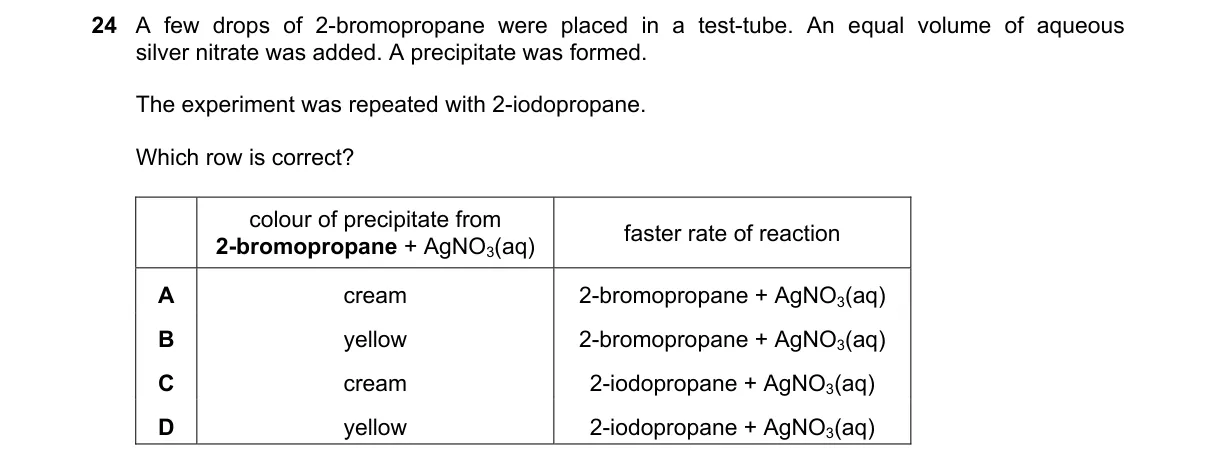
Answer choices
- A2-bromopropane + AgNO3(aq) 2-bromopropane + AgNO3(aq)
- Byellow 2-iodopropane + AgNO3(aq) 2-iodopropane + AgNO3(aq)
- Cyellow 2-bromopropane + AgNO3(aq)
- Dyellow 2-iodopropane + AgNO3(aq)
Explanation
Silver nitrate test identifies halide precipitates by color
Steps:
- Aqueous AgNO3 reacts with alkyl halides to form insoluble AgX precipitates via SN1 mechanism in polar solvent.
- 2-Bromopropane (R-Br) yields AgBr, a pale yellow precipitate.
- 2-Iodopropane (R-I) yields AgI, a yellow precipitate.
- The test confirms both form precipitates, but colors distinguish bromide (pale yellow) from iodide (yellow).
Why C is correct:
- Option C correctly identifies yellow precipitate for 2-bromopropane with AgNO3(aq), matching AgBr formation as per halide reactivity series.
Why the others are wrong:
- A incorrectly suggests no precipitate or unspecified reaction for both compounds.
- B wrongly attributes yellow precipitate only to 2-iodopropane, ignoring bromide's reaction.
- D misplaces yellow observation solely to 2-iodopropane without addressing bromide.
Final answer: C
Topic: Halogen compounds
Practice more A Levels Chemistry (9701) questions on mMCQ.me