A Levels Chemistry (9701)•9701/12/M/J/21
A Levels Chemistry (9701) — 9701/12/M/J/21, Question 19
Ammonia gas, NH3, and hydrogen sulfide, H2S, react together to form the salt ammonium sulfide, (NH4)2S. (NH3(g) + H2S(g) → (NH4)2S(aq) → NH4+(aq) + S2−(aq) orange alkaline solution. The addition of HCl(aq) to this solution produces a gas, X. X and Y could represent different gases or identical gases. What are X and Y?
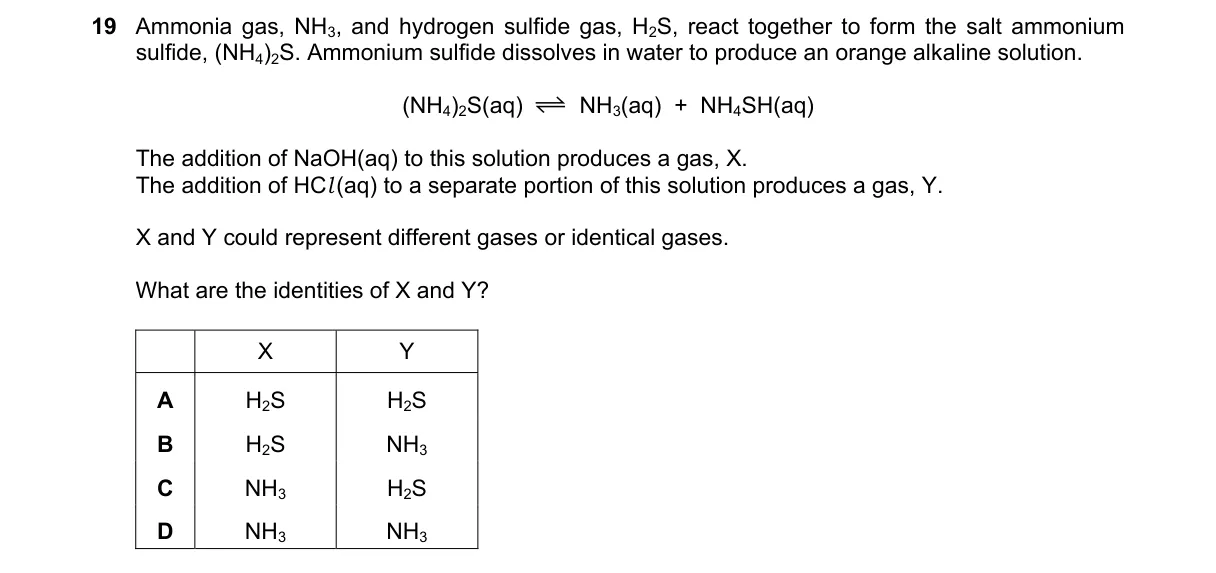
Answer choices
- AH2S H2S
- BNH3 H2S
- CH2S NH3
- DNH3 NH3
Explanation
Acid-base reactions in ammonium sulfide solution
Steps:
- NH3 and H2S form (NH4)2S(aq), dissociating to NH4+ and S2- in alkaline solution.
- Adding HCl provides H+, protonating S2- to HS- then H2S(g), so X is H2S.
- The resulting solution contains NH4+ and Cl- after H2S release.
- Adding NaOH to this solution deprotonates NH4+ to NH3(g), so Y is NH3.
Why C is correct:
- C matches X as H2S from sulfide protonation (S2- + 2H+ → H2S) and Y as NH3 from ammonium basification (NH4+ + OH- → NH3 + H2O).
Why the others are wrong:
- A: Y is not H2S, as basification does not regenerate sulfide gas.
- B: X is not NH3, since acidification targets S2- first, not NH4+.
- D: Neither gas is NH3; X comes from sulfide, not ammonia.
Final answer: C
Topic: Nitrogen and sulfur
Practice more A Levels Chemistry (9701) questions on mMCQ.me