A Levels Chemistry (9701)•9701/12/M/J/21
A Levels Chemistry (9701) — 9701/12/M/J/21, Question 15
Z is an anhydrous compound of a Group 2 element. When it is heated, Z undergoes thermal decomposition to produce two different gases. Z has relatively low thermal stability compared to other Group 2 compounds containing the same anion as Z. What is compound Z?
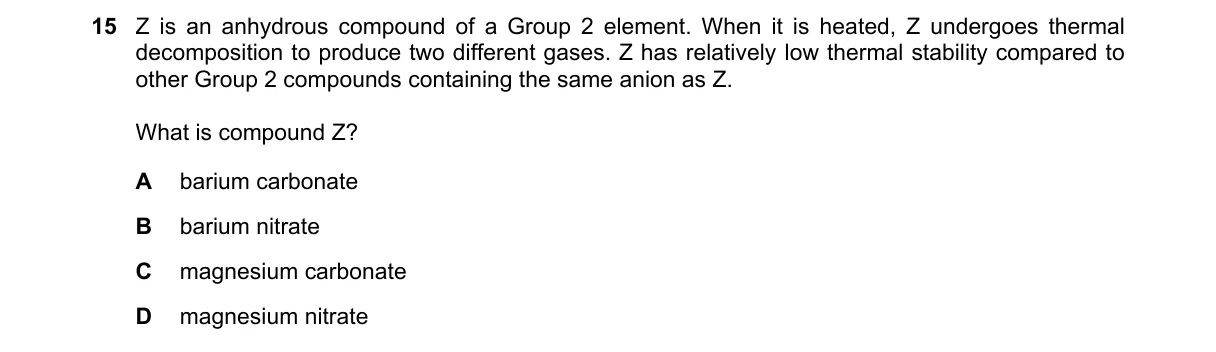
Answer choices
- Abarium carbonate
- Bbarium nitrate
- Cmagnesium carbonate
- Dmagnesium nitrate
Explanation
Thermal decomposition of Group 2 nitrates yields two gases with stability increasing down the group
Steps:
- Decomposition producing two gases identifies nitrates, as 2M(NO3)2 → 2MO + 4NO2 + O2.
- Carbonates decompose to one gas: MO + CO2.
- Low thermal stability compared to other Group 2 compounds with same anion points to magnesium nitrate, as stability rises down Group 2 due to decreasing charge density.
- Barium compounds are more stable, confirming magnesium nitrate as Z.
Why D is correct:
- Mg(NO3)2 decomposes to MgO + NO2 + O2 (two gases); its low stability follows Fajans' rules, where small Mg2+ highly polarizes and destabilizes NO3- relative to larger cations.
Why the others are wrong:
- A. Barium carbonate decomposes to BaO + CO2 (one gas).
- B. Barium nitrate has higher thermal stability than magnesium nitrate.
- C. Magnesium carbonate decomposes to MgO + CO2 (one gas).
Final answer: D
Topic: Group 2
Practice more A Levels Chemistry (9701) questions on mMCQ.me