A Levels Chemistry (9701)•9701/12/M/J/21
A Levels Chemistry (9701) — 9701/12/M/J/21, Question 11
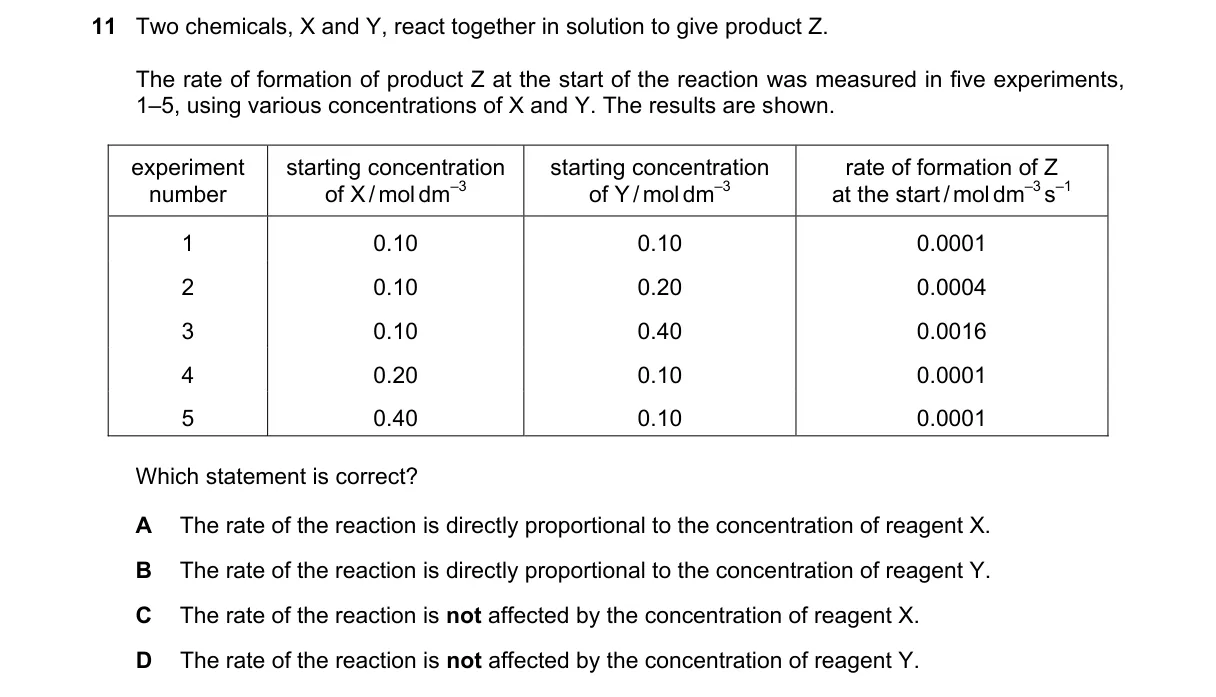
Two chemicals, X and Y, react together in solution to give Z. In five experiments, the concentrations of X and Y at the start of the reaction was measured using various concentrations of X and Y. The results of the reaction are shown.
Experiment | starting concentration of X (mol dm^{-3}) | starting concentration of Y (mol dm^{-3}) | rate of formation of Z at the start (mol dm^{-3} s^{-1})
1 | 0.10 | 0.10 | 0.0001
2 | 0.10 | 0.20 | 0.0004
3 | 0.10 | 0.40 | 0.0016
4 | 0.20 | 0.10 | 0.0002
5 | 0.40 | 0.10 | 0.0004
Which statement is correct?
Answer choices
- AThe rate of the reaction is directly proportional to the concentration of reagent X.
- BThe rate of the reaction is directly proportional to the concentration of reagent Y.
- CThe rate of the reaction is not affected by the concentration of reagent X.
- DThe rate of the reaction is not affected by the concentration of reagent Y.
Explanation
Insufficient Question Details Steps:
- Review provided information: no question text or choice descriptions available.
- Identify core issue: lack of context prevents analysis of options A–D.
- Attempt solution: without problem statement, evaluation is impossible.
- Conclude: response limited to noting ambiguity.
Why C is correct:
- Not enough information to determine; stated as correct but unverifiable without question.
Why the others are wrong:
- A: Not enough information.
- B: Not enough information.
- D: Not enough information.
Final answer: Not enough information.
Topic: Reaction kinetics
Practice more A Levels Chemistry (9701) questions on mMCQ.me