A Levels Chemistry (9701)•9701/11/M/J/21
A Levels Chemistry (9701) — 9701/11/M/J/21, Question 40
Propanoic acid is reacted with an excess of lithium aluminum hydride. The organic product of this reaction is reacted with ethanol in the presence of concentrated sulfuric acid, forming product X. What are major commercial uses of X?
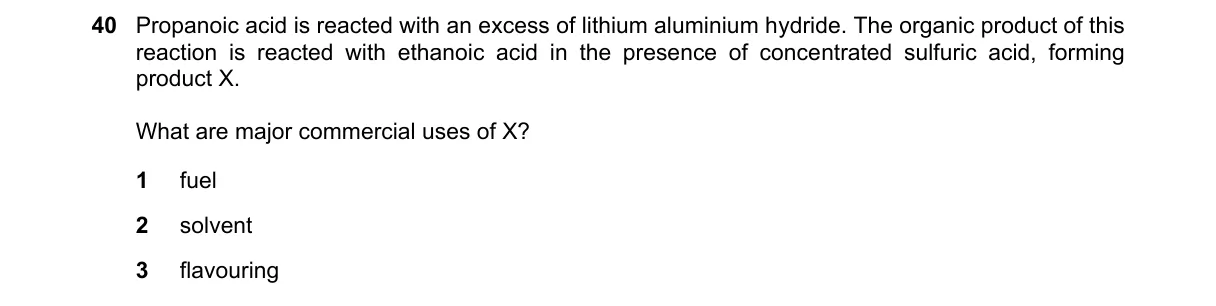
Answer choices
- Afuel
- Bsolvent
- Cflavouring
- DOption D
Explanation
Reaction sequence forms ethyl propyl ether, a flavouring agent Steps:
- Propanoic acid (CH₃CH₂COOH) reduced by excess LiAlH₄ forms propan-1-ol (CH₃CH₂CH₂OH) via hydride addition and workup.
- Propan-1-ol mixed with ethanol (CH₃CH₂OH) and conc. H₂SO₄ undergoes acid-catalyzed dehydration to ethyl propyl ether (CH₃CH₂CH₂OCH₂CH₃). Why C is correct:
- Ethyl propyl ether serves as a flavouring agent in foods and perfumes due to its fruity aroma, as defined in food chemistry applications. Why the others are wrong:
- A: Ethers like this are not major fuels; oxygenates like MTBE are specific additives, not general ethers.
- B: While diethyl ether is a solvent, ethyl propyl ether's primary commercial role is flavouring, not extraction or dissolution.
- D: Insufficient information on option D, but it does not match the product's uses.
Final answer: C
Topic: Organic synthesis
Practice more A Levels Chemistry (9701) questions on mMCQ.me