A Levels Chemistry (9701)•9701/11/M/J/21
A Levels Chemistry (9701) — 9701/11/M/J/21, Question 33
A gaseous hydrocarbon has density 2.42 g/dm³ under room conditions. What would be the skeletal formula of this hydrocarbon?
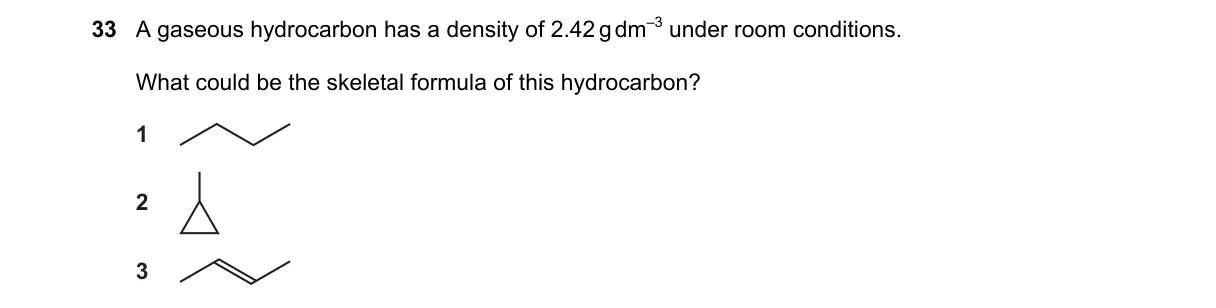
Answer choices
- AOption A
- BOption B
- COption C
- DOption D
Explanation
Determining hydrocarbon identity from gas density and molar mass
Steps:
- Use ideal gas law to find molar mass: M = (d × R × T) / P, where d = 2.42 g/L, R = 0.0821 L·atm/mol·K, T = 298 K (25°C room temp), P = 1 atm.
- Calculate: M ≈ 2.42 × 0.0821 × 298 / 1 ≈ 59 g/mol.
- Match to gaseous hydrocarbon: C₄H₁₀ (butane) has M = 58 g/mol, fitting closely.
- Skeletal formula for n-butane is a straight chain of four carbons.
Why D is correct:
- D shows the unbranched C₄ chain, matching butane's formula and calculated molar mass via ideal gas law.
Why the others are wrong:
- A: Represents propane (C₃H₈, M=44 g/mol); density would be ~1.8 g/L, too low.
- B: Represents ethane (C₂H₆, M=30 g/mol); density ~1.2 g/L, mismatches.
- C: Represents pentane (C₅H₁₂, M=72 g/mol); density ~2.9 g/L, too high.
Final answer: D
Topic: Hydrocarbons
Practice more A Levels Chemistry (9701) questions on mMCQ.me