A Levels Chemistry (9701)•9701/11/M/J/21
A Levels Chemistry (9701) — 9701/11/M/J/21, Question 28
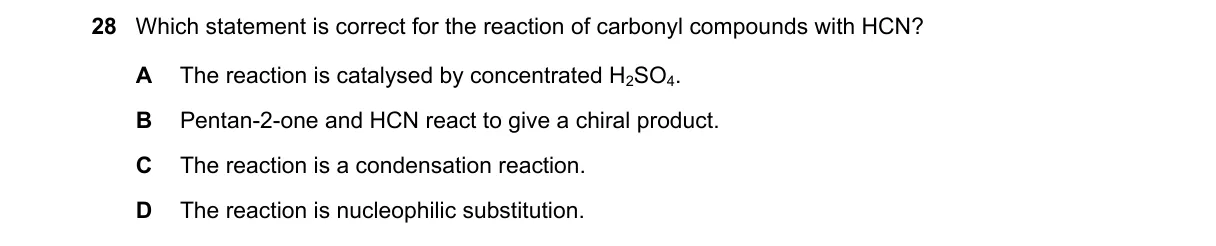
Which statement is correct for the reaction of carbonyl compounds with HCN?
Answer choices
- AThe reaction is catalysed by concentrated H2SO4.
- BPentan-2-one and HCN react to give a chiral product.
- CThe reaction is a condensation reaction.
- DThe reaction is nucleophilic substitution.
Explanation
Nucleophilic Addition of HCN to Carbonyls
Steps:
- Identify reaction type: HCN adds to C=O forming cyanohydrin via CN⁻ nucleophile attacking carbonyl carbon.
- Evaluate catalysis: requires base like KCN to generate CN⁻, not acid.
- Assess product for pentan-2-one: CH₃C(O)CH₂CH₂CH₃ yields CH₃C(OH)(CN)CH₂CH₂CH₃ with chiral C bearing four different groups.
- Classify overall: addition reaction, not substitution or condensation.
Why B is correct:
- Pentan-2-one's carbonyl carbon attaches to CH₃ and propyl groups, so cyanohydrin has a tetrahedral chiral center per stereochemistry definition.
Why the others are wrong:
- A: Reaction uses base catalysis (e.g., KCN/H⁺), not concentrated H₂SO₄ which protonates carbonyl.
- C: No small molecule elimination; it's pure addition, not condensation.
- D: CN⁻ adds to C=O without displacing group, unlike substitution.
Final answer: B
Topic: Carbonyl compounds
Practice more A Levels Chemistry (9701) questions on mMCQ.me