A Levels Chemistry (9701)•9701/11/M/J/21
A Levels Chemistry (9701) — 9701/11/M/J/21, Question 25
When an organic compound is oxidized, any oxygen atom gained by the organic molecule is considered to be from H2O, also producing 2H+ + 2e-. Any hydrogen atom lost may be considered to be from H+ + e-. These changes can be represented H2O → O + 2H+ + 2e-. Compound X is oxidized by acidified potassium dichromate(V). The half-equation for the reduction reaction is shown. Cr2O7 2- + 14H+ + 6e- → 2Cr3+ + 7H2O. Under these conditions, one mole of potassium dichromate(V) oxidises three moles of X. What could be compound X?
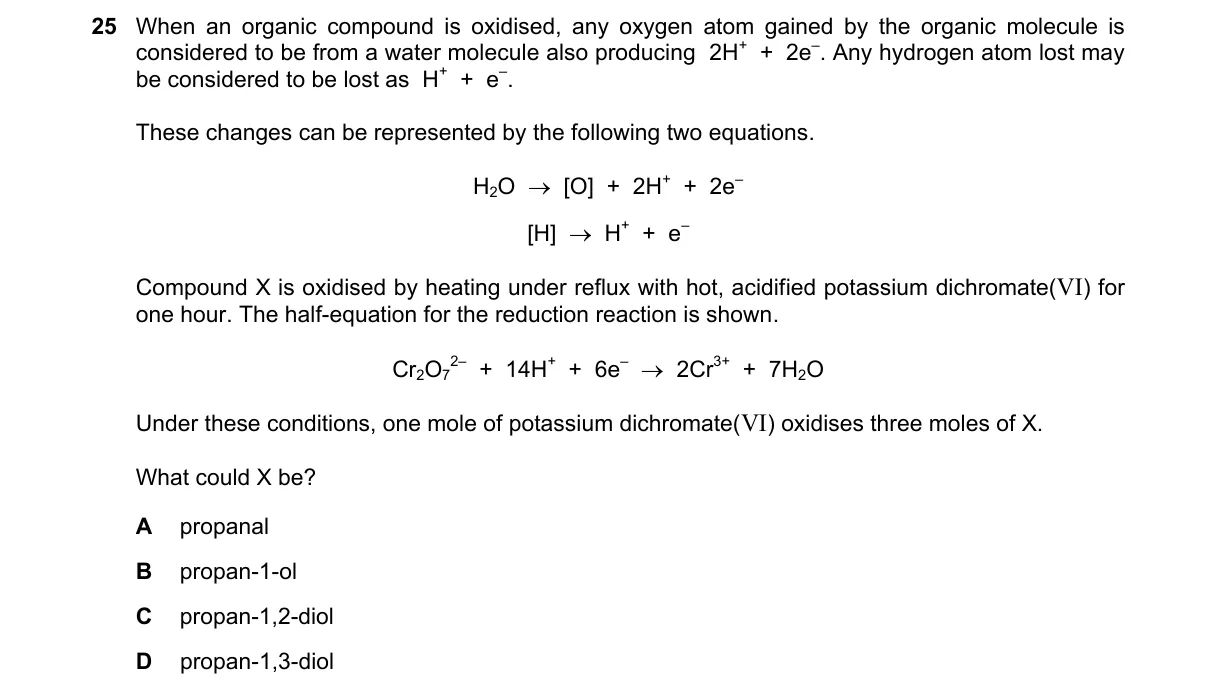
Answer choices
- Apropan-1-ol
- Bpropan-1,2-diol
- Cpropan-1,3-diol
- Dpropan-2-ol
Explanation
Stoichiometry of oxidation indicates 2-electron transfer per molecule of X
Steps:
- Dichromate reduction accepts 6 electrons per mole of Cr₂O₇²⁻.
- One mole of dichromate oxidizes 3 moles of X, so 6 electrons total from 3 X, meaning 2 electrons per X.
- Oxidation half-equation for X involves net loss of 2H⁺ + 2e⁻.
- Propan-1-ol oxidizes to propanal (CH₃CH₂CH₂OH → CH₃CH₂CHO + 2H⁺ + 2e⁻), matching 2-electron change.
Why A is correct:
- Primary alcohol propan-1-ol loses 2 hydrogen atoms to form aldehyde, a 2-electron oxidation consistent with the 3:1 molar ratio and policy for hydrogen loss (H⁺ + e⁻ per H).
Why the others are wrong:
- B. Propan-1,2-diol has adjacent OH groups; oxidation affects both (4e⁻ for primary to acid + 2e⁻ for secondary to ketone = 6e⁻ total).
- C. Propan-1,3-diol has two primary OH groups, requiring 4e⁻ each for carboxylic acids (8e⁻ total).
- D. Propan-2-ol oxidizes to ketone (2e⁻), but conditions favor primary alcohol partial oxidation to aldehyde for the given ratio.
Final answer: A
Topic: Hydroxy compounds
Practice more A Levels Chemistry (9701) questions on mMCQ.me