A Levels Chemistry (9701)•9701/11/M/J/21
A Levels Chemistry (9701) — 9701/11/M/J/21, Question 24
The compound cetyl palmitate, C15H31CO2C16H33, is a wax. Cetyl palmitate is heated under reflux with an excess of aqueous sodium hydroxide. Which products will be formed?
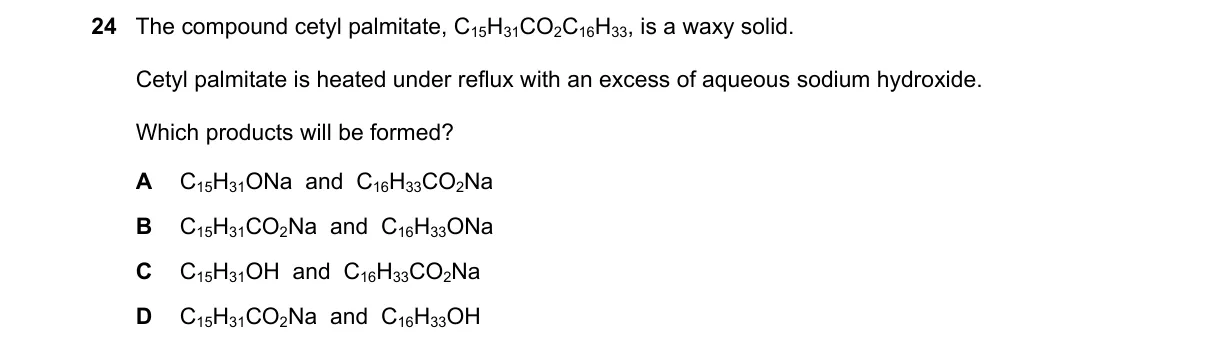
Answer choices
- AC15H31CO2Na and C16H33OH
- BC15H31CO2Na and C16H33ONa
- CC15H31COONa and C16H33OH
- DC15H31COONa and C16H33ONa
Explanation
Ester Saponification Reaction Steps:
- Recognize C15H31CO2C16H33 as an ester (RCOOR', R = C15H31, R' = C16H33).
- Heating under reflux with excess aqueous NaOH triggers saponification (base hydrolysis).
- The reaction cleaves the ester bond: RCOOR' + NaOH → RCO2Na + R'OH.
- Products are sodium carboxylate (C15H31CO2Na) and alcohol (C16H33OH).
Why A is correct:
- Matches the standard saponification products, where aqueous NaOH forms the carboxylate salt and neutral alcohol per the reaction RCO2R' + NaOH → RCO2Na + R'OH.
Why the others are wrong:
- B: Shows alcohol as C16H33ONa (alkoxide), but aqueous NaOH does not deprotonate the alcohol (pKa ~16).
- C: Uses inconsistent notation (COONa vs. question's CO2); A aligns with given formula.
- D: Shows both as salts, including alcohol alkoxide, which forms only in anhydrous conditions, not aqueous.
Final answer: A
Topic: Carboxylic acids and derivatives
Practice more A Levels Chemistry (9701) questions on mMCQ.me