A Levels Chemistry (9701)•9701/11/M/J/21
A Levels Chemistry (9701) — 9701/11/M/J/21, Question 17
The volatility of the Group 17 elements, chlorine, bromine and iodine, decreases down the group. What is responsible for this trend?
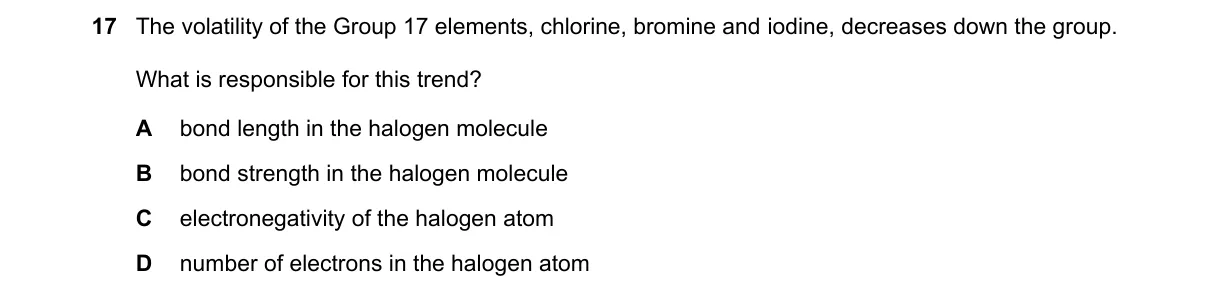
Answer choices
- Abond length in the halogen molecule
- Belectronegativity of the halogen atom
- Cbond strength in the halogen molecule
- Dnumber of electrons in the halogen atom
Explanation
Volatility decreases due to increasing London dispersion forces
Steps:
- Volatility measures ease of vaporization; it decreases as boiling points rise for Cl2 (gas), Br2 (liquid), I2 (solid).
- Boiling points increase down Group 17 because intermolecular forces strengthen.
- London dispersion forces, the main intermolecular force for nonpolar X2 molecules, grow with atomic size and electron count.
- More electrons down the group enhance temporary dipoles, raising boiling points and lowering volatility.
Why D is correct:
- Number of electrons increases from Cl (17) to I (53), per atomic number trend, boosting dispersion forces via greater polarizability (ability to form induced dipoles).
Why the others are wrong:
- A: Bond length increases but affects intramolecular bonds, not intermolecular forces driving volatility.
- B: Electronegativity decreases down the group, irrelevant to nonpolar X2 dispersion forces.
- C: Bond strength decreases (weaker X-X bonds), but volatility trend stems from intermolecular, not covalent, interactions.
Final answer: D
Topic: Group 17
Practice more A Levels Chemistry (9701) questions on mMCQ.me