A Levels Chemistry (9701)•9701/11/M/J/21
A Levels Chemistry (9701) — 9701/11/M/J/21, Question 14
A mixture of Group 2 oxide and Group 2 sulfate contains equal amounts of the two compounds. Q is shaken with water and the resulting mixture is filtered. A solid residue is obtained. The filtrate is shaken with H2SO4(aq). What produces a white precipitate.
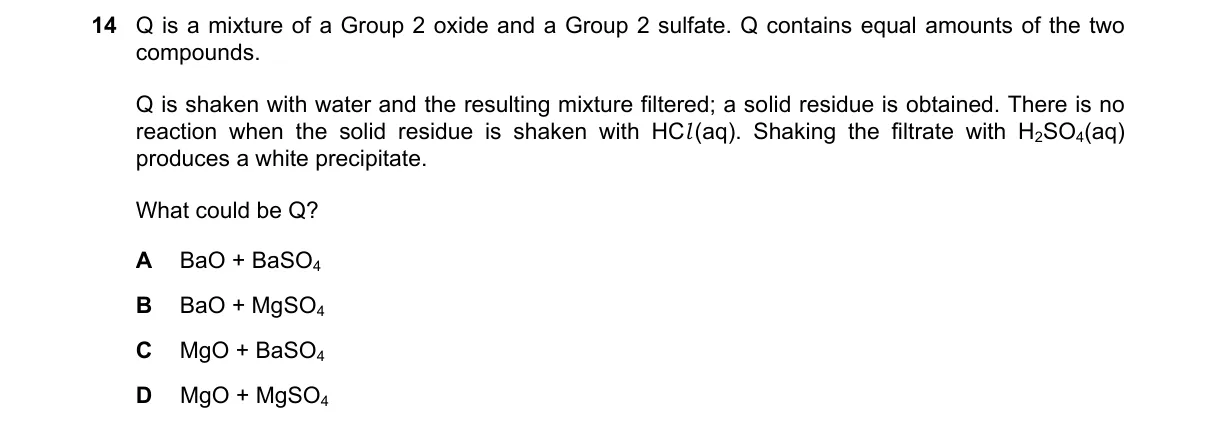
Answer choices
- ABaO + BaSO4
- BMgO + MgSO4
- CBaO + MgSO4
- DMgO + BaSO4
Explanation
Solubility of Group 2 hydroxides and sulfates determines residue and precipitate
Steps:
- Shake mixture with water: Group 2 oxide reacts to form hydroxide; soluble hydroxide enters filtrate, insoluble sulfate remains as residue.
- Filter: Solid residue is insoluble sulfate (e.g., BaSO4); filtrate contains dissolved hydroxide (e.g., Ba(OH)2).
- Add H2SO4 to filtrate: Soluble barium hydroxide forms insoluble BaSO4 white precipitate; magnesium hydroxide is insoluble, so no precipitate from its filtrate.
- Identify mixture: Only BaO + BaSO4 yields residue and white precipitate in filtrate.
Why A is correct:
- Ba(OH)2 (soluble) in filtrate reacts with H2SO4 to form BaSO4 (insoluble white precipitate), per solubility rules for Group 2 compounds.
Why the others are wrong:
- B: Filtrate is MgSO4 (soluble); no precipitate with H2SO4.
- C: Both Ba(OH)2 and MgSO4 soluble; no solid residue obtained.
- D: Filtrate empty (both Mg(OH)2 and BaSO4 insoluble); no precipitate forms.
Final answer: A
Topic: Group 2
Practice more A Levels Chemistry (9701) questions on mMCQ.me