A Levels Chemistry (9701)•9701/11/M/J/21
A Levels Chemistry (9701) — 9701/11/M/J/21, Question 13
The gaseous products of heating a mixture of Ca(OH)2 and NH4Cl are passed through solid CaO. A single gaseous product W is collected. A sample of W reacts with V(g) to produce two gases X and Y. X is an element. Y is acidic. Y reacts with W and Z. What are X, Y and Z?
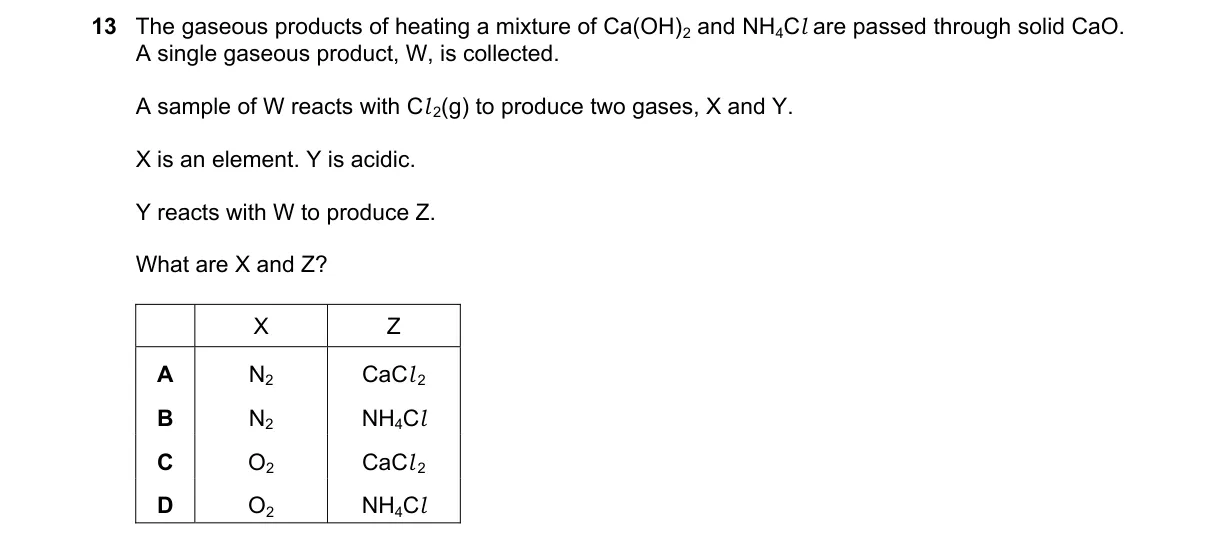
Answer choices
- AX = N2, Z = CaCl2
- BX = N2, Z = NH4Cl
- CX = O2, Z = CaCl2
- DX = O2, Z = NH4Cl
Explanation
Thermal decomposition yields NH3, reacting with Cl2 to identify products Steps:
- Heating Ca(OH)₂ and NH₄Cl produces NH₃ and H₂O gases via Ca(OH)₂ + 2NH₄Cl → CaCl₂ + 2NH₃ + 2H₂O.
- Passing gases through solid CaO absorbs H₂O (CaO + H₂O → Ca(OH)₂), so W = NH₃.
- NH₃ (W) reacts with Cl₂ (V) to give N₂ (X, elemental gas) and HCl (Y, acidic gas): 2NH₃ + 3Cl₂ → N₂ + 6HCl.
- HCl (Y) reacts with NH₃ (W) to form NH₄Cl (Z): NH₃ + HCl → NH₄Cl. Why B is correct:
- Z = NH₄Cl matches the product of acidic Y (HCl) reacting with basic W (NH₃), per acid-base neutralization. Why the others are wrong:
- A: Z = CaCl₂ incorrect; Y (HCl) reacts with NH₃, not to form CaCl₂.
- C: X = O₂ incorrect; reaction produces N₂, not O₂, with no oxygen source.
- D: X = O₂ and Z = NH₄Cl inconsistent; X must be N₂ from the Cl₂ reaction.
Final answer: B
Topic: Group 2
Practice more A Levels Chemistry (9701) questions on mMCQ.me