A Levels Chemistry (9701)•9701/13/M/J/20
A Levels Chemistry (9701) — 9701/13/M/J/20, Question 34
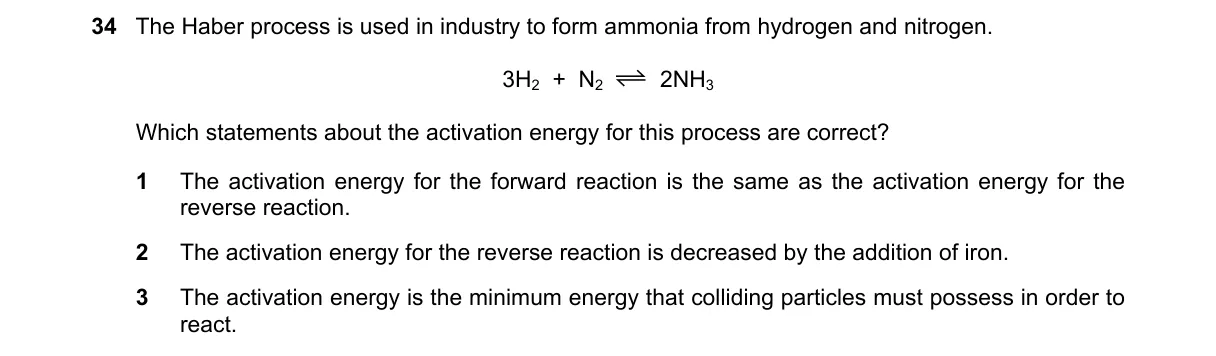
The Haber process is used in industry to form ammonia from hydrogen and nitrogen. 3H2 + N2 ⇌ 2NH3 Which statements about the activation energy for this process are correct?
Answer choices
- AThe activation energy for the forward reaction is the same as the activation energy for the reverse reaction.
- BThe activation energy for the forward reaction is decreased by the addition of iron.
- CThe activation energy is the minimum energy that colliding particles must possess in order to react.
- DThe activation energy for the reverse reaction is decreased by addition of iron.
Explanation
Activation Energy in Reversible Reactions
Steps:
- Recall activation energy (Ea) is the minimum energy required for effective collisions to form products.
- Note catalysts like iron lower Ea for both forward and reverse reactions equally in equilibrium systems.
- Compare Ea for forward (higher) and reverse (lower by ΔH) reactions in exothermic Haber process.
- Evaluate statements: A mismatches Ea values; B and D ignore equal catalyst effect; C matches definition.
Why C is correct:
- Activation energy is defined as the minimum kinetic energy colliding particles need to overcome the energy barrier and react, per collision theory.
Why the others are wrong:
- A: Ea forward exceeds Ea reverse by the exothermic reaction's enthalpy change (ΔH < 0).
- B: Iron catalyst reduces Ea for both directions equally, not just forward.
- D: Iron decreases Ea for reverse reaction equally with forward, maintaining equilibrium.
Final answer: C
Topic: Reaction kinetics
Practice more A Levels Chemistry (9701) questions on mMCQ.me