A Levels Chemistry (9701)•9701/13/M/J/20
A Levels Chemistry (9701) — 9701/13/M/J/20, Question 33
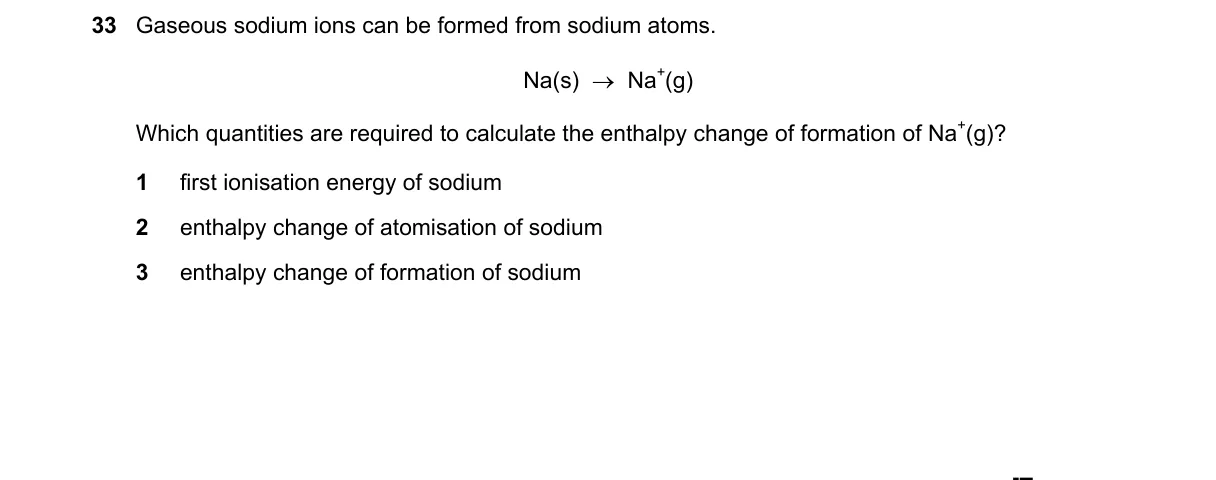
Gaseous sodium ions can be formed from atoms. Na(s) → Na+(g) Which quantities are required to calculate the enthalpy change of formation of Na+(g)?
Answer choices
- Afirst ionisation energy of sodium
- Benthalpy change of atomisation of sodium
- Centhalpy change of formation of sodium
- DOption D
Explanation
Standard enthalpy of formation requires steps from elemental solid state
Steps:
- Define the process: ΔH_f[Na+(g)] is the enthalpy change for Na(s) → Na+(g).
- Apply Hess's law: Break into Na(s) → Na(g) and Na(g) → Na+(g).
- Identify ΔH for Na(s) → Na(g) as atomisation enthalpy.
- Note ΔH for Na(g) → Na+(g) as first ionisation energy; both sum to total ΔH_f.
Why B is correct:
- Enthalpy change of atomisation is ΔH for Na(s) → Na(g), the initial step from standard state to gaseous atom, required by the definition of standard enthalpy of formation.
Why the others are wrong:
- A: First ionisation energy applies only after atomisation; insufficient alone for the full process from solid.
- C: Enthalpy change of formation of sodium (Na(s)) is zero by convention for elements in standard state; provides no useful value.
Not enough information for option D.
Final answer: B
Topic: Chemical energetics
Practice more A Levels Chemistry (9701) questions on mMCQ.me