A Levels Chemistry (9701)•9701/13/M/J/20
A Levels Chemistry (9701) — 9701/13/M/J/20, Question 23
Butanoic acid can be produced from 1-bromopropane in two steps using reagents V and W 1-bromopropane reagent V compound Q reagent W butanoic acid What would be reagents V and W
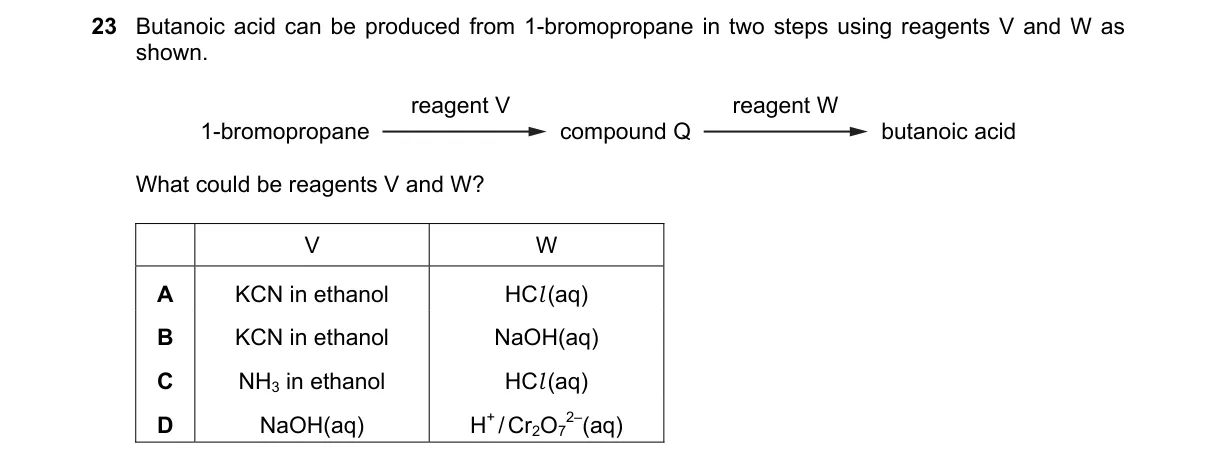
Answer choices
- AKCN in ethanol, HCl(aq) in ethanol
- BKCN in ethanol, NaOH(aq)
- CNH3 in ethanol, HNO3(aq) in ethanol
- DNaOH(aq), H^+(aq)
Explanation
Nucleophilic substitution with cyanide followed by nitrile hydrolysis
Steps:
- 1-Bromopropane undergoes SN2 reaction with KCN in ethanol to form 1-cyanopropane (compound Q), adding one carbon.
- Compound Q (nitrile) is hydrolyzed with HCl(aq) in ethanol to butanoic acid via protonation and water addition.
- This two-step process extends the chain from C3 to C4 and converts the nitrile to carboxylic acid.
Why A is correct:
- KCN replaces Br with CN (R-Br + CN⁻ → R-CN + Br⁻), and HCl hydrolyzes nitrile to carboxylic acid (R-CN + 2H₂O + HCl → R-COOH + NH₄Cl).
Why the others are wrong:
- B: NaOH hydrolyzes nitrile to carboxylate salt (R-COO⁻ Na⁺), not the acid.
- C: NH₃ forms primary amine (propylamine), and HNO₃ nitration doesn't yield carboxylic acid.
- D: NaOH gives propan-1-ol via substitution, and H⁺ alone doesn't extend chain or form acid.
Final answer: A
Topic: Organic synthesis
Practice more A Levels Chemistry (9701) questions on mMCQ.me