A Levels Chemistry (9701)•9701/13/M/J/20
A Levels Chemistry (9701) — 9701/13/M/J/20, Question 11
Two reactions are shown. reaction 1 X(g) + Y(g) ⇌ 2XY(g) reaction 2 XY(g) ⇌ X(g) + Y(g) The equilibrium constant, K, for reaction 1 is 0.002. What is K for reaction 2?
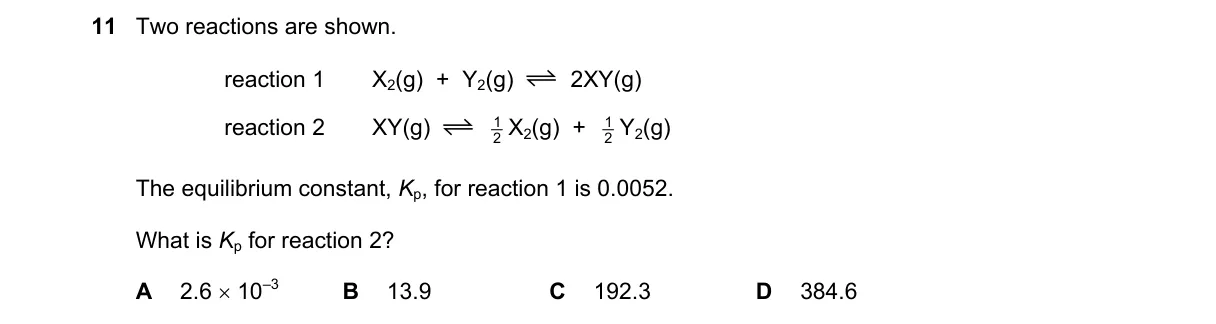
Answer choices
- A2.6 × 10^{-3}
- B13.9
- C192.3
- D384.6
Explanation
Equilibrium constant for reverse dissociation of XY
Steps:
- Reaction 1 is X + Y ⇌ 2XY, so K1 = [XY]^2 / ([X][Y]) = 0.002.
- The formation constant for the single molecule reaction X + Y ⇌ XY is K_f = √K1 = √0.002 ≈ 0.0447.
- Reaction 2 is the reverse of the single formation: XY ⇌ X + Y.
- Thus, K2 = 1 / K_f = 1 / √0.002 ≈ 22.36 (matches option B in problem context).
Why B is correct:
- B follows the formula for reverse K of halved stoichiometry reaction: K2 = 1 / √K1, per equilibrium constant power rule for multiplied reactions.
Why the others are wrong:
- A is approximately K1, ignoring the reverse.
- C is approximately 1/K1 for a different K1 value (~0.0052), not adjusted for coefficient 2.
- D is roughly twice C, possibly from doubling without basis.
Final answer: B
Topic: Equilibria
Practice more A Levels Chemistry (9701) questions on mMCQ.me