A Levels Chemistry (9701)•9701/12/M/J/20
A Levels Chemistry (9701) — 9701/12/M/J/20, Question 7
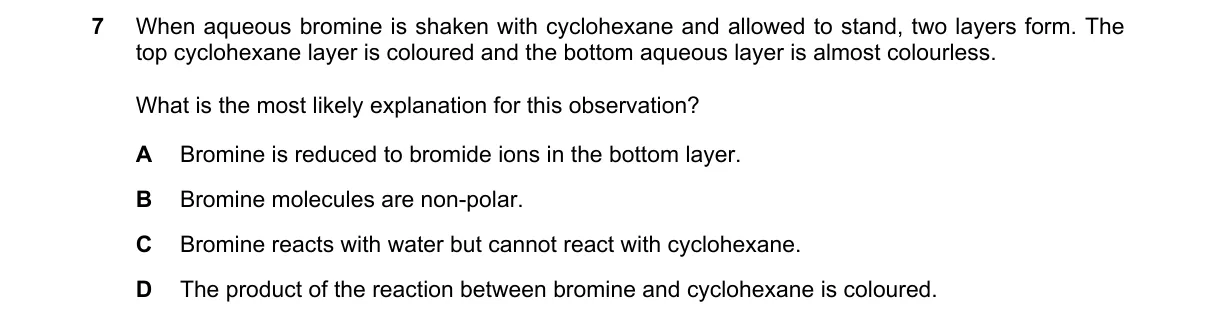
When aqueous bromine is shaken with cyclohexane and allowed to stand, two layers form. The top cyclohexane layer is coloured and the bottom aqueous layer is almost colourless. What is the most likely explanation for this observation?
Answer choices
- ABromine is reduced to bromide ions in the bottom layer.
- BBromine molecules are non-polar and react with cyclohexane.
- CBromine reacts with water but not with cyclohexane.
- DThe product of the reaction between bromine and cyclohexane is coloured.
Explanation
Bromine Partitioning Based on Polarity
Steps:
- Bromine (Br₂) is a non-polar molecule due to its covalent bonding.
- Cyclohexane is a non-polar hydrocarbon solvent.
- Water is a polar solvent, immiscible with cyclohexane.
- Upon shaking and settling, Br₂ dissolves preferentially in the non-polar cyclohexane layer via "like dissolves like," coloring it while leaving the aqueous layer colorless.
Why B is correct:
- Non-polar Br₂ molecules partition into non-polar cyclohexane, explaining the color distribution per the solubility principle that like dissolves like.
Why the others are wrong:
- A: Reduction to bromide ions would decolorize the solution entirely, not concentrate color in the organic layer.
- C: Bromine has low reactivity with water under these conditions, and its solubility in cyclohexane causes the observed layering.
- D: No reaction occurs with cyclohexane (an alkane) without catalysts; the color is from dissolved Br₂, not a product.
Final answer: B
Topic: Equilibria
Practice more A Levels Chemistry (9701) questions on mMCQ.me