A Levels Chemistry (9701)•9701/12/M/J/20
A Levels Chemistry (9701) — 9701/12/M/J/20, Question 3
The catalysed formation of ammonia by the Haber process can be represented by the equation N₂(g) + 3H₂(g) ⇌ 2NH₃(g) ΔH = -92 kJ mol⁻¹. Which change in conditions will increase both the rate of formation and the equilibrium yield of ammonia?
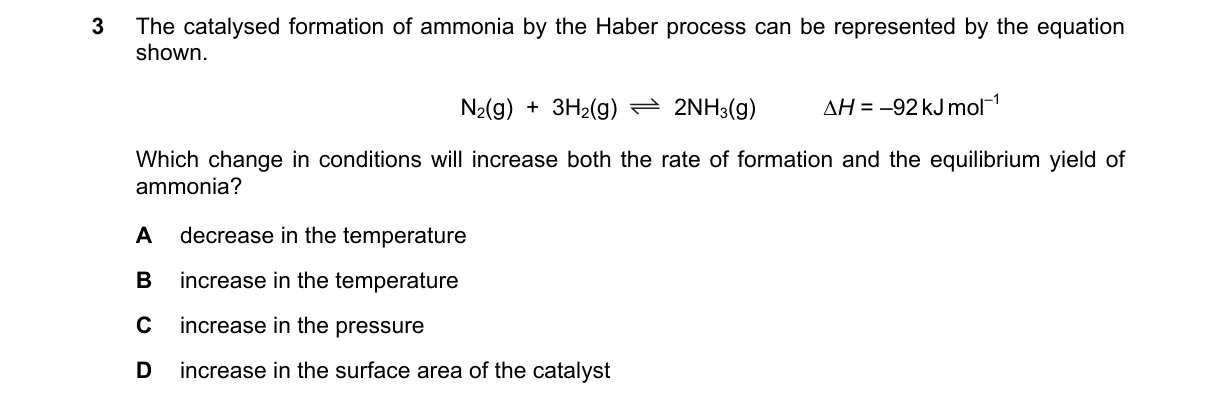
Answer choices
- Adecrease in the temperature
- Bincrease in the pressure
- Cincrease in the surface area of the catalyst
- DOption D
Explanation
Pressure Effects on Rate and Yield in Haber Process Steps:
- Reaction is exothermic (ΔH negative), so decreasing temperature shifts equilibrium right (higher NH₃ yield) but slows rate by reducing kinetic energy.
- Increasing pressure shifts equilibrium right (fewer gas moles on product side) per Le Chatelier's principle, increasing yield; it also raises reactant concentrations, speeding up rate via more collisions.
- Increasing catalyst surface area provides more active sites, accelerating rate without altering equilibrium position or yield.
- No option D provided, so evaluate A–C only.
Why B is correct:
- Higher pressure increases both rate (higher concentration speeds collisions) and yield (Le Chatelier's principle favors fewer moles).
Why the others are wrong:
- A decreases rate while increasing yield.
- C increases rate but leaves yield unchanged (catalysts speed attainment of equilibrium, not position).
Final answer: B
Topic: Equilibria
Practice more A Levels Chemistry (9701) questions on mMCQ.me