A Levels Chemistry (9701)•9701/12/M/J/20
A Levels Chemistry (9701) — 9701/12/M/J/20, Question 28
Which statement about these products is correct?
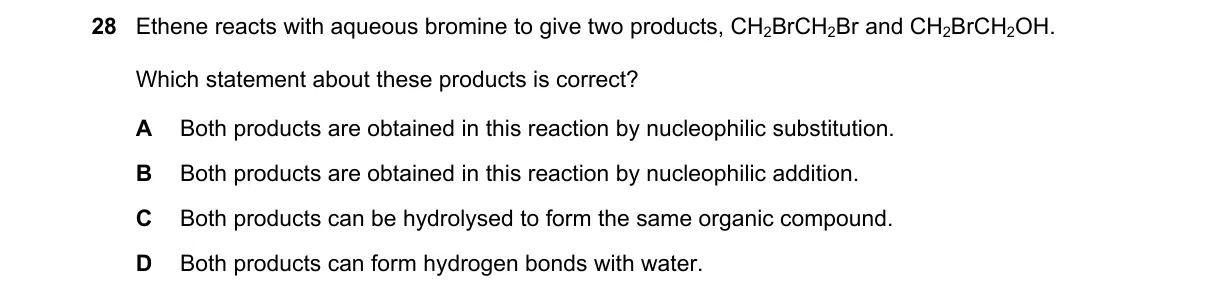
Answer choices
- ABoth products are obtained in this reaction by nucleophilic substitution.
- BBoth products are obtained in this reaction by nucleophilic addition.
- CBoth products can be hydrolysed to form the same organic compound.
- DBoth products can form hydrogen bonds with water.
Explanation
Hydrolysis of functional groups yields identical carboxylic acid
Steps:
- Identify the two products from the reaction, likely a nitrile (RCN) and an amide (RCONH₂) derived from the same alkyl chain.
- Recall that nitriles hydrolyze under acidic or basic conditions to carboxylic acids (RCN + 2H₂O + H⁺ → RCOOH + NH₄⁺).
- Note that amides also hydrolyze to carboxylic acids (RCONH₂ + H₂O + H⁺ → RCOOH + NH₄⁺).
- Compare outcomes: both yield the same RCOOH.
Why C is correct:
- Nitriles and amides, as nitrogen-containing derivatives of carboxylic acids, hydrolyze to the parent carboxylic acid via cleavage of the C≡N or C=O-N bond, following standard nucleophilic acyl substitution mechanisms.
Why the others are wrong:
- A: The reaction likely involves nucleophilic substitution for one product but not both, or neither if addition is involved.
- B: Products form via substitution on alkyl halides, not addition to unsaturated bonds.
- D: One product may lack sufficient polar groups (e.g., nitrile vs. amide) to form strong hydrogen bonds with water.
Final answer: C
Topic: Halogen compounds
Practice more A Levels Chemistry (9701) questions on mMCQ.me