A Levels Chemistry (9701)•9701/12/M/J/20
A Levels Chemistry (9701) — 9701/12/M/J/20, Question 14
Which statement explains why iodine is less volatile than chlorine?
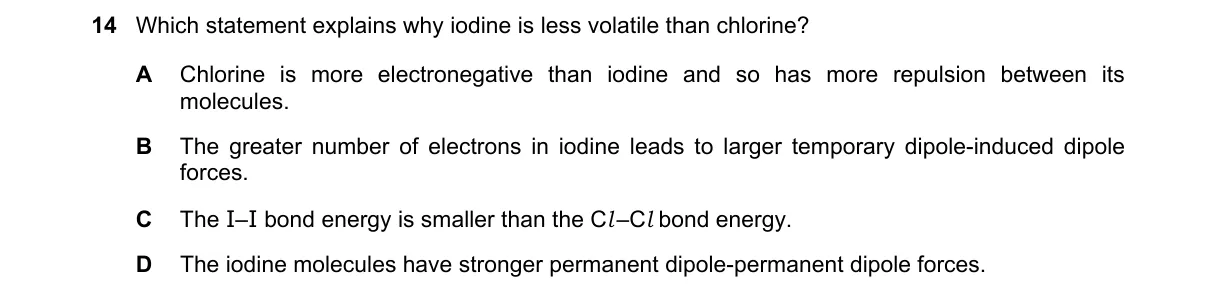
Answer choices
- AChlorine is more electronegative than iodine and so has more repulsion between its molecules.
- BThe greater number of electrons in iodine leads to larger temporary dipole-induced dipole forces.
- CThe I-I bond energy is smaller than the Cl-Cl bond energy.
- DThe iodine molecules have stronger permanent dipole-permanent dipole forces.
Explanation
Volatility and Intermolecular Forces in Halogens
Steps:
- Volatility inversely relates to strength of intermolecular forces; stronger forces mean higher boiling point and lower volatility.
- Both chlorine (Cl₂) and iodine (I₂) are nonpolar diatomic molecules, so intermolecular forces are temporary dipole-induced dipole (London dispersion) forces.
- Iodine has more electrons (106 vs. 34 in chlorine) and larger atomic size, leading to stronger dispersion forces.
- Thus, iodine's stronger forces make it less volatile than chlorine.
Why B is correct:
- London dispersion forces increase with the number of electrons, as more electrons create larger temporary dipoles that induce stronger attractions in neighboring molecules.
Why the others are wrong:
- A: Electronegativity difference doesn't cause repulsion between nonpolar molecules; it affects bond polarity, not intermolecular forces here.
- C: Bond energy refers to intramolecular bonds (Cl-Cl is actually stronger than I-I), but volatility depends on intermolecular forces, not bond breaking.
- D: Neither molecule has a permanent dipole, as they are homonuclear and nonpolar, so no permanent dipole forces exist.
Final answer: B
Topic: Group 17
Practice more A Levels Chemistry (9701) questions on mMCQ.me