A Levels Chemistry (9701)•9701/11/M/J/20
A Levels Chemistry (9701) — 9701/11/M/J/20, Question 36
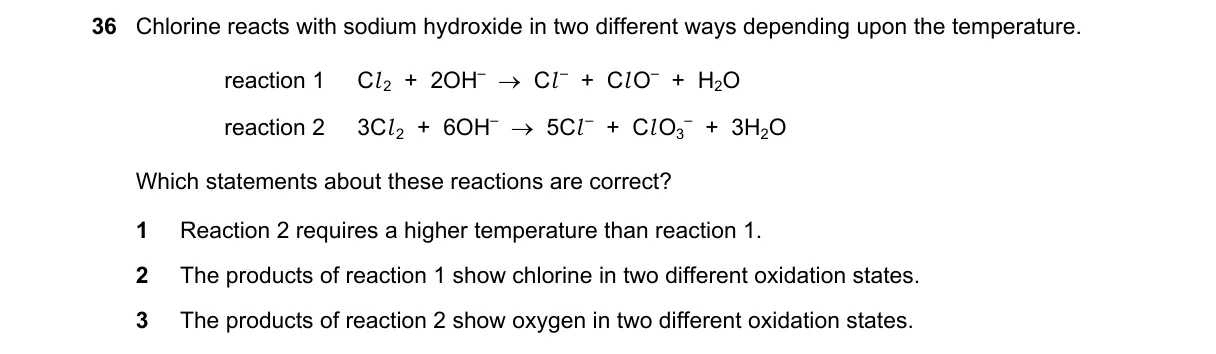
Chlorine reacts with sodium hydroxide in two different ways depending upon temperature.
Reaction 1: Cl₂ + 2OH⁻ → Cl⁻ + ClO⁻ + H₂O
Reaction 2: 3Cl₂ + 6OH⁻ → 5Cl⁻ + ClO₃⁻ + 3H₂O
Which statement about these reactions is correct?
Answer choices
- AReaction 2 requires a higher temperature than reaction 1.
- BThe products of reaction 1 show chlorine in two different oxidation states.
- CThe products of reaction 2 show oxygen in two different oxidation states.
- DOption D
Explanation
Oxidation States in Reaction Products
Steps:
- Identify products of reaction 1: Cl⁻ and ClO⁻ (H₂O contains no chlorine).
- Determine oxidation state of Cl in Cl⁻: -1 (as chloride ion).
- Determine oxidation state of Cl in ClO⁻: +1 (O is -2, charge -1, so Cl = +1).
- Confirm two distinct states for Cl: -1 and +1.
Why B is correct:
- In reaction 1 products, Cl shows oxidation states -1 (in Cl⁻) and +1 (in ClO⁻), per standard oxidation number rules.
Why the others are wrong:
- A: The reactions depend on temperature, but no details specify which requires higher temperature.
- C: In reaction 2 products (Cl⁻, ClO₃⁻, H₂O), all O atoms are -2, same state.
- D: Option incomplete, cannot evaluate.
Final answer: B
Topic: Group 17
Practice more A Levels Chemistry (9701) questions on mMCQ.me