A Levels Chemistry (9701)•9701/11/M/J/20
A Levels Chemistry (9701) — 9701/11/M/J/20, Question 35
The catalytic converters fitted to cars remove pollutants from the exhaust gases. Some of the reactions that occur involve oxygen, which comes from the air. Which pollutant in the exhaust gases will react with oxygen on the surface of the catalytic converter?
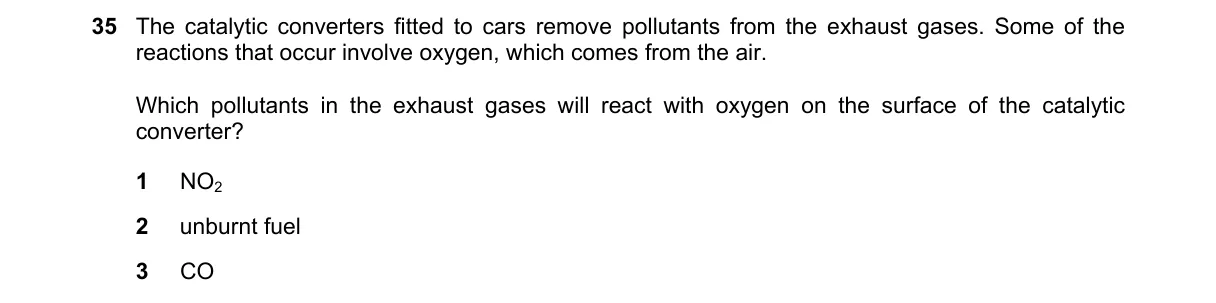
Answer choices
- ANO
- Bunburnt fuel
- CCO
- DOption D
Explanation
Catalytic oxidation of CO in exhaust gases
Steps:
- Exhaust pollutants include CO, NO, and unburnt hydrocarbons from incomplete combustion.
- Catalytic converters use platinum/rhodium to facilitate oxidation (with O2) and reduction reactions.
- Oxidation targets CO and hydrocarbons, converting them to CO2 and H2O using air-supplied oxygen.
- CO specifically undergoes 2CO + O2 → 2CO2 on the catalyst surface.
Why C is correct:
- CO reacts with oxygen via catalytic oxidation: 2CO + O2 → 2CO2, removing it as a pollutant.
Why the others are wrong:
- A. NO undergoes reduction (2NO → N2 + O2), not oxidation with added oxygen.
- B. Unburnt fuel (hydrocarbons) oxidizes with O2, but CO is the direct match for the reaction described.
- D. Not enough information (option unspecified).
Final answer: C
Topic: Chemistry of transition elements
Practice more A Levels Chemistry (9701) questions on mMCQ.me