A Levels Chemistry (9701)•9701/11/M/J/20
A Levels Chemistry (9701) — 9701/11/M/J/20, Question 22
But-1-ene and but-2-ene are treated separately with cold, dilute acidified manganate(VII) ions. Four students, W, X, Y and Z, make statements about these alkenes and the diols formed from them. W One diol contains a primary and a secondary alcohol group. X One diol contains a primary alcohol group. Y One diol contains a secondary alcohol group. Z Both alkenes exhibit cis-trans isomerism. Which two students are correct?
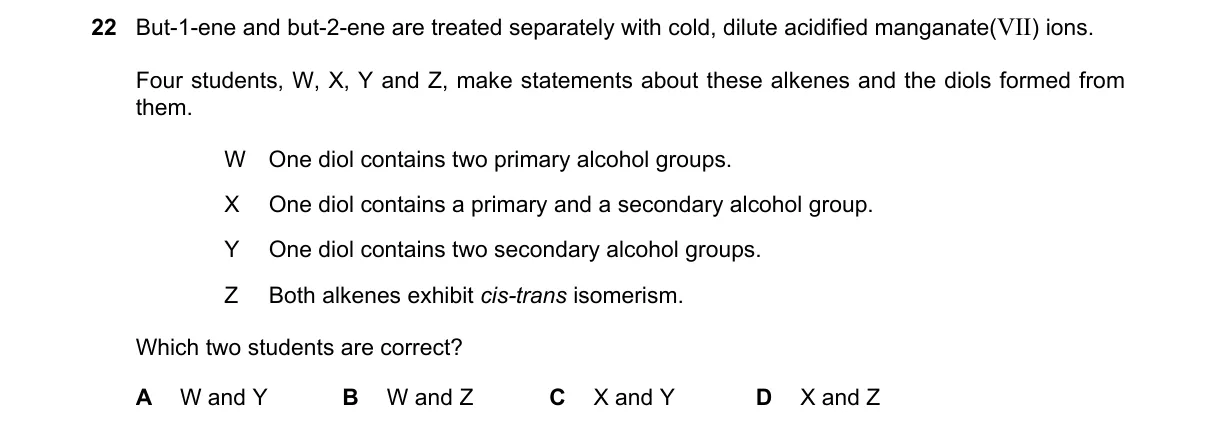
Answer choices
- AW and Y
- BW and Z
- CX and Y
- DX and Z
Explanation
Alcohol types in vicinal diols from alkene dihydroxylation Steps:
- Cold, dilute acidified MnO₄⁻ adds two OH groups syn to the double bond, forming diols.
- But-1-ene (CH₂=CHCH₂CH₃) yields butane-1,2-diol: HOCH₂CH(OH)CH₂CH₃ (primary OH at C1, secondary OH at C2).
- But-2-ene (CH₃CH=CHCH₃) yields butane-2,3-diol: CH₃CH(OH)CH(OH)CH₃ (two secondary OH groups at C2, C3).
- X correct: butane-1,2-diol has primary OH; Y correct: butane-1,2-diol (and butane-2,3-diol) has secondary OH.
Why C is correct:
- X and Y accurately state that at least one diol has a primary OH and at least one has a secondary OH, per alcohol classification (primary: OH on CH₂R; secondary: OH on CHR₂).
Why the others are wrong:
- A. W and Y: W incorrect because butane-2,3-diol has only secondary OH groups, not primary and secondary.
- B. W and Z: Z incorrect because but-1-ene lacks cis-trans isomerism (one =C has two H atoms).
- D. X and Z: Z incorrect because but-1-ene lacks cis-trans isomerism (one =C has two H atoms).
Final answer: C
Topic: Hydrocarbons
Practice more A Levels Chemistry (9701) questions on mMCQ.me