A Levels Chemistry (9701)•9701/11/M/J/20
A Levels Chemistry (9701) — 9701/11/M/J/20, Question 1
Ethene can be oxidised to form epoxyethane, C2H4O. C2H4(g) + 1/2 O2(g) ⇌ C2H4O(g) ΔH = -97 kJ mol^{-1} Which set of conditions gives the greatest yield of epoxyethane at equilibrium?
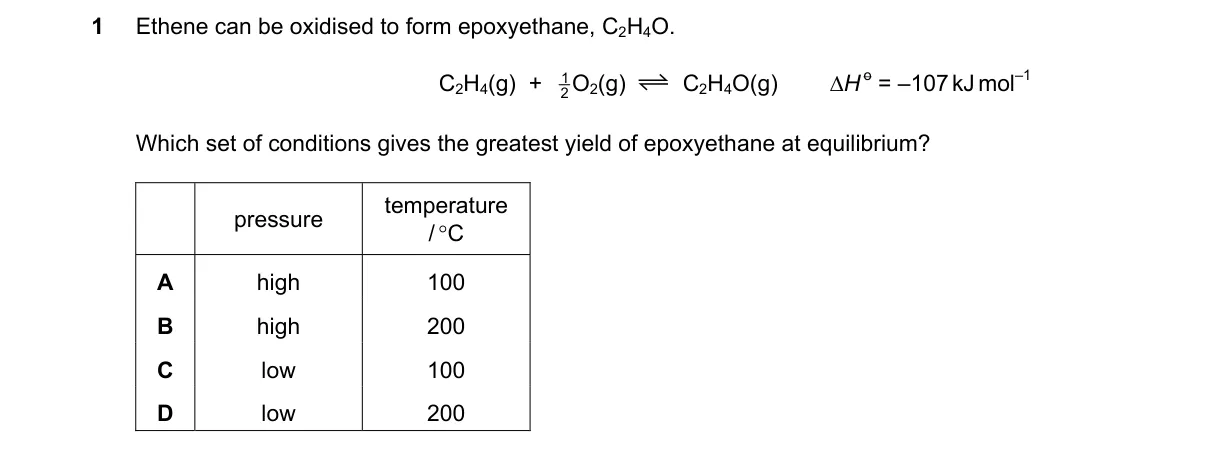
Answer choices
- Ahigh pressure, 100 °C
- Blow pressure, 200 °C
- Chigh pressure, 200 °C
- Dlow pressure, 100 °C
Explanation
Le Chatelier's Principle for Yield Optimization
Steps:
- Reaction is exothermic (ΔH negative), so lower temperature favors forward reaction by shifting equilibrium right.
- Gaseous moles decrease from 2 to 1, so higher pressure favors products by shifting equilibrium right.
- Temperature affects rate but equilibrium position favors lower T for exothermic reactions.
- Pressure has no temperature interaction, so combine high pressure with low temperature for maximum yield.
Why A is correct:
- High pressure increases yield (fewer moles on product side); 100 °C (lower temperature) favors exothermic forward reaction per Le Chatelier's principle.
Why the others are wrong:
- B: Low pressure decreases yield (more moles on reactant side); 200 °C shifts equilibrium left for exothermic reaction.
- C: High pressure increases yield, but 200 °C shifts equilibrium left, reducing product.
- D: Low pressure decreases yield despite 100 °C favoring forward reaction.
Final answer: A
Topic: Equilibria
Practice more A Levels Chemistry (9701) questions on mMCQ.me