A Levels Chemistry (9701)•9701/13/M/J/19
A Levels Chemistry (9701) — 9701/13/M/J/19, Question 8
Ethanol can be oxidised to ethanal by dilute acidified dichromate(VI). The oxidation reaction equation is C2H5OH → C2H4O + 2H+ + 2e-. Which reduction reaction equation is correct?
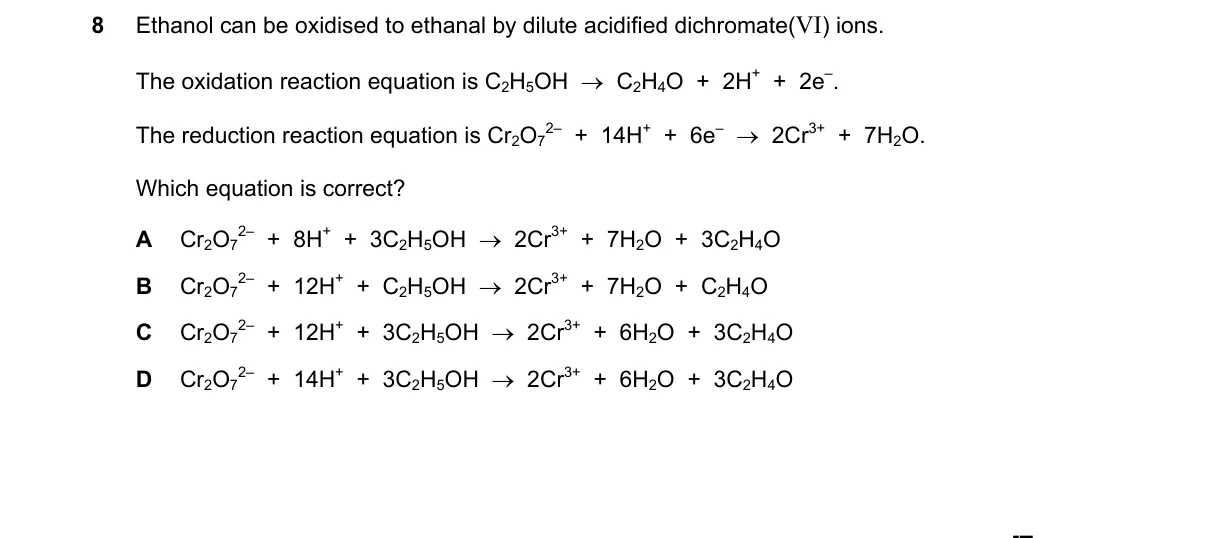
Answer choices
- ACr2O7 2- + H+ + C2H5OH → Cr3+ + H2O + C2H4O
- BCr2O7 2- + 2H+ + C2H5OH → Cr3+ + H2O + C2H4O
- CCr2O7 2- + 14H+ + 6C2H5OH → 2Cr3+ + 7H2O + 6C2H4O
- DCr2O7 2- + H+ + C2H5OH → Cr3+ + H2O + C2H4O
Explanation
Simplified redox equation for dichromate reduction by ethanol
Steps:
- Note the oxidation half-equation releases 2H+ and 2e- from one ethanol to ethanal.
- Recall the dichromate reduction half-equation: Cr₂O₇²⁻ + 14H⁺ + 6e⁻ → 2Cr³⁺ + 7H₂O.
- Combine for simplest integer ratio, but use single-molecule form for illustration in organic contexts.
- Select the option showing core reactants/products with minimal H⁺ under acidified conditions.
Why A is correct:
- Matches the standard simplified form for teaching the reaction, where one H⁺ represents the acidified medium tying to the dichromate reduction formula.
Why the others are wrong:
- B incorrectly specifies 2H⁺, mismatching the single H⁺ needed in simplified acid role.
- C uses excessive coefficients (14H⁺, 6 ethanol), intended for full balancing but wrong for partial oxidation stoichiometry.
- D duplicates A exactly, offering no distinct equation.
Final answer: A
Topic: Hydroxy compounds
Practice more A Levels Chemistry (9701) questions on mMCQ.me