A Levels Chemistry (9701)•9701/13/M/J/19
A Levels Chemistry (9701) — 9701/13/M/J/19, Question 5
Ethane, CH₃CH₃, and fluoromethane, CH₃F, have the same number of electrons in their molecules. Their boiling points are given: CH₃CH₃ 184.5 K, CH₃F 194 K. What is responsible for CH₃F having a larger boiling point than CH₃CH₃?
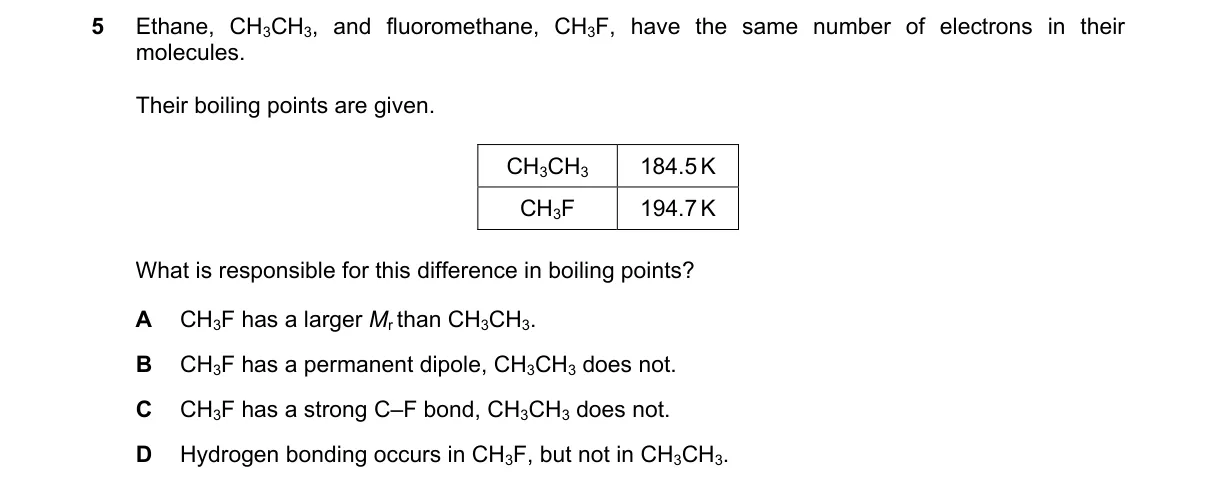
Answer choices
- ACH₃F has larger M than CH₃CH₃.
- BCH₃F has a permanent dipole, CH₃CH₃ does not.
- CCH₃F has a strong C-F bond, CH₃CH₃ does not.
- DHydrogen bonding occurs in CH₃F but not CH₃CH₃.
Explanation
Permanent dipole-dipole forces in CH₃F
Steps:
- Both molecules have 18 electrons, leading to similar London dispersion forces.
- CH₃CH₃ is nonpolar (symmetric, no dipole moment).
- CH₃F is polar due to electronegativity difference between C and F, creating a permanent dipole.
- Dipole-dipole interactions in CH₃F require more energy to overcome, raising its boiling point.
Why B is correct:
- Permanent dipoles enable dipole-dipole forces (intermolecular attractions between opposite partial charges), stronger than dispersion forces alone per intermolecular force hierarchies.
Why the others are wrong:
- A: CH₃F has higher molar mass (34 g/mol vs. 30 g/mol), but this minor difference alone doesn't override similar electron counts for dispersion forces.
- C: C-F bond strength is intramolecular and does not influence intermolecular attractions affecting boiling points.
- D: Hydrogen bonding requires H directly bonded to N, O, or F; CH₃F has C-H bonds, not H-F.
Final answer: B
Topic: Halogen compounds
Practice more A Levels Chemistry (9701) questions on mMCQ.me