A Levels Chemistry (9701)•9701/13/M/J/19
A Levels Chemistry (9701) — 9701/13/M/J/19, Question 24
Water is added to a sample of 2,3-dibromohexane. Some of the 2,3-dibromohexane undergoes complete hydrolysis and some of it undergoes partial hydrolysis. What is not present in the mixture of products?
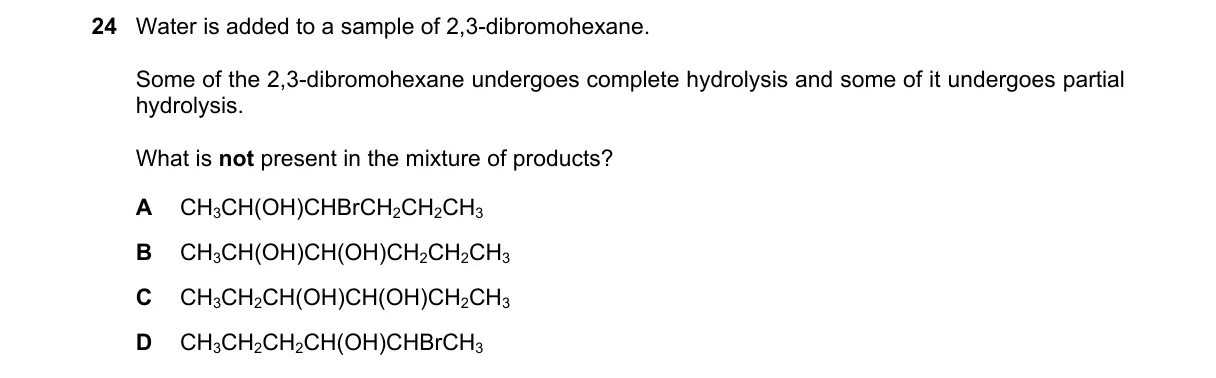
Answer choices
- ACH3CH(OH)CHBrCH2CH2CH3
- BCH3CHBrCH(OH)CH2CH2CH3
- CCH3CH(OH)CH(OH)CH2CH2CH3
- DCH3CHBrCHBrCH2CH2CH3
Explanation
Vicinal dibromides do not form diols via hydrolysis with water alone
Steps:
- 2,3-Dibromohexane has adjacent Br groups on secondary carbons, allowing SN1/SN2 substitution with water.
- Partial hydrolysis replaces one Br with OH, yielding constitutional isomers A (OH at C2) and B (OH at C3) as bromohydrins.
- The intermediate bromohydrin has adjacent OH and Br, which under hydrolysis conditions favors epoxide formation over second substitution.
- Thus, complete hydrolysis does not produce the vicinal diol; products are only bromohydrins A and B.
Why C is correct:
- Vicinal diols require base-catalyzed epoxide opening or Ag2O(aq); neutral water halts at bromohydrin stage per standard organic mechanisms.
Why the others are wrong:
- A: Forms via partial hydrolysis substituting Br at C2.
- B: Forms via partial hydrolysis substituting Br at C3.
- D: Starting material remains if reaction incomplete, present in mixture.
Final answer: C
Topic: Halogen compounds
Practice more A Levels Chemistry (9701) questions on mMCQ.me