A Levels Chemistry (9701)•9701/13/M/J/19
A Levels Chemistry (9701) — 9701/13/M/J/19, Question 16
The solids sodium chloride and sodium iodide both react with concentrated sulfuric acid at room temperature. With NaCl, the products are NaHSO4, HCl. With NaI, the products are NaHSO4, HI, SO2, H2S. What is the explanation for this difference in products?
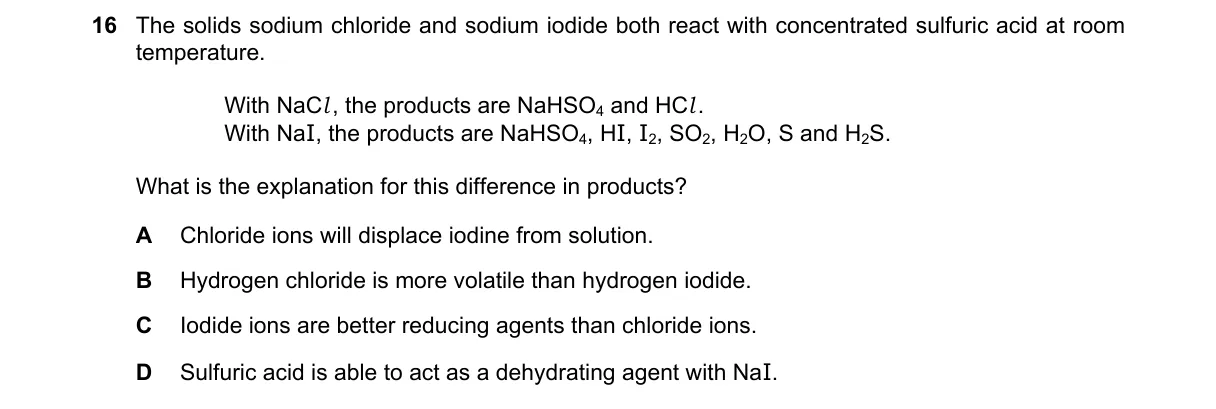
Answer choices
- AChloride ions will displace iodide from solution.
- BHydrogen chloride is more volatile than hydrogen iodide.
- CIodide ions are better reducing agents than chloride ions.
- DSulfuric acid is able to act as a dehydrating agent with NaI.
Explanation
Iodide reduces sulfuric acid due to stronger reducing power
Steps:
- Concentrated H2SO4 protonates both Cl- and I- to form HX (HCl or HI) and NaHSO4.
- HCl is stable and escapes as gas without further reaction.
- HI, however, reduces H2SO4 because I- is easily oxidized to I2.
- This reduction produces SO2 and H2S alongside HI and NaHSO4.
Why C is correct:
- Iodide ions are better reducing agents than chloride ions, as I- has lower standard reduction potential (E° for I2/2I- is +0.54 V vs. +1.36 V for Cl2/2Cl-), favoring oxidation of I- by H2SO4.
Why the others are wrong:
- A: No displacement of iodide by chloride occurs; reactions are separate.
- B: Volatility difference exists but does not explain extra products like SO2 and H2S.
- D: Dehydration is not primary; reduction by I- drives the unique products.
Final answer: C
Topic: Group 17
Practice more A Levels Chemistry (9701) questions on mMCQ.me