A Levels Chemistry (9701)•9701/13/M/J/19
A Levels Chemistry (9701) — 9701/13/M/J/19, Question 10
X and Y react together to form Z in a reversible reaction. The equilibrium yield of Z is lower at higher temperature. Which equation could represent this?
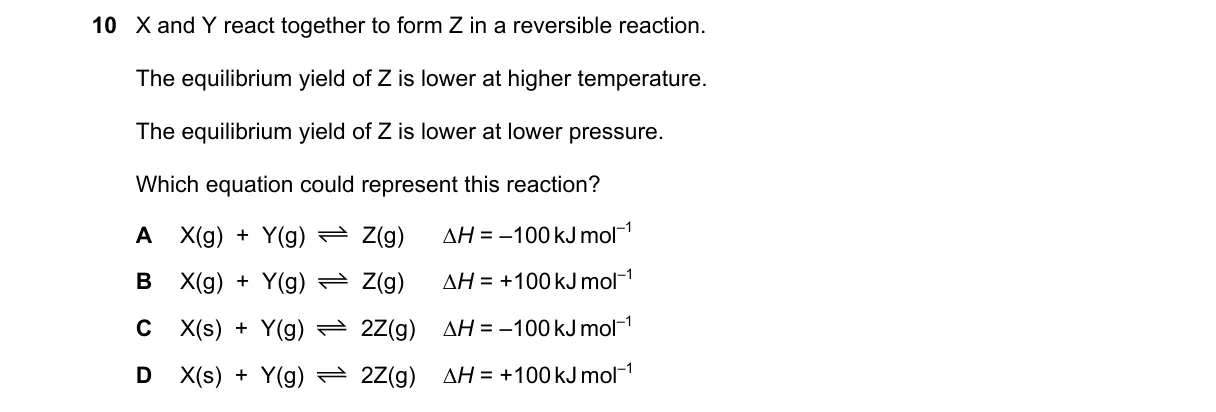
Answer choices
- AX(g) + Y(g) ⇌ Z(g) ΔH = +100 kJ mol^{-1}
- BX(g) + Y(g) ⇌ Z(l) ΔH = -100 kJ mol^{-1}
- CX(g) + Y(g) ⇌ Z(g) ΔH = -100 kJ mol^{-1}
- DX(g) + Y(g) ⇌ Z(l) ΔH = +100 kJ mol^{-1}
Explanation
Le Chatelier's principle for exothermic equilibria
Steps:
- Lower yield of Z at higher temperature means increasing T shifts equilibrium left, decreasing products.
- Le Chatelier's principle states higher temperature favors the endothermic direction.
- Thus, reverse reaction is endothermic, so forward reaction (forming Z) is exothermic with ΔH < 0.
- Option C has ΔH = -100 kJ mol^{-1} and all gaseous reactants/products.
Why C is correct:
- Negative ΔH indicates exothermic forward reaction; per Le Chatelier's principle, higher temperature shifts equilibrium left, reducing Z yield.
Why the others are wrong:
- A: Positive ΔH (endothermic forward); higher temperature increases Z yield.
- B: Negative ΔH, but Z(l) implies phase change; temperature effect on liquid-gas equilibrium not purely ΔH-driven without more info.
- D: Positive ΔH and Z(l); higher temperature would increase Z yield.
Final answer: C
Topic: Equilibria
Practice more A Levels Chemistry (9701) questions on mMCQ.me