A Levels Chemistry (9701)•9701/12/M/J/19
A Levels Chemistry (9701) — 9701/12/M/J/19, Question 40
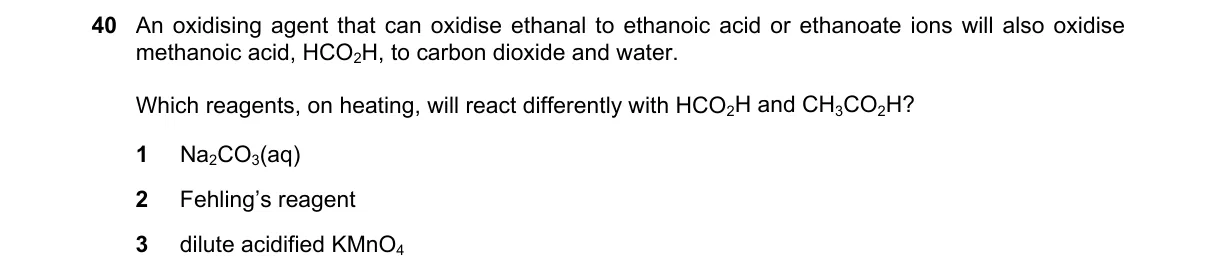
An oxidising agent that can oxidise ethanol to ethanoic acid or ethanoate ions will also oxidise methanoic acid, HCOOH, to carbon dioxide and water. Which reagents, on heating, will react differently with HCOOH and CH3COOH?
Answer choices
- ANa2CO3(aq)
- BFehling's reagent
- Cdilute acidified KMnO4
- DOption D
Explanation
Oxidants distinguishing HCOOH from CH3COOH by further oxidation
Steps:
- Strong oxidants convert CH3CH2OH to CH3COOH and HCOOH to CO2 + H2O.
- These oxidants stop at CH3COOH, so no reaction with it.
- Reagents reacting differently: oxidize HCOOH (e.g., decolorize) but not CH3COOH.
- Evaluate options for this selective oxidation behavior.
Why C is correct:
- Dilute acidified KMnO4 oxidizes HCOOH to CO2 (purple to colorless) but CH3COOH resists oxidation, per standard organic redox.
Why the others are wrong:
- A: Both HCOOH and CH3COOH react with Na2CO3(aq) to evolve CO2 gas equally.
- B: Fehling's reagent tests aldehydes/reductants but does not oxidize ethanol to ethanoic acid.
Final answer: C
Topic: Carboxylic acids and derivatives
Practice more A Levels Chemistry (9701) questions on mMCQ.me