A Levels Chemistry (9701)•9701/12/M/J/19
A Levels Chemistry (9701) — 9701/12/M/J/19, Question 34
The manufacture of ammonia from nitrogen and hydrogen is an important industrial process. Which of the following would leave the equilibrium constant, K, for the formation of ammonia unchanged?
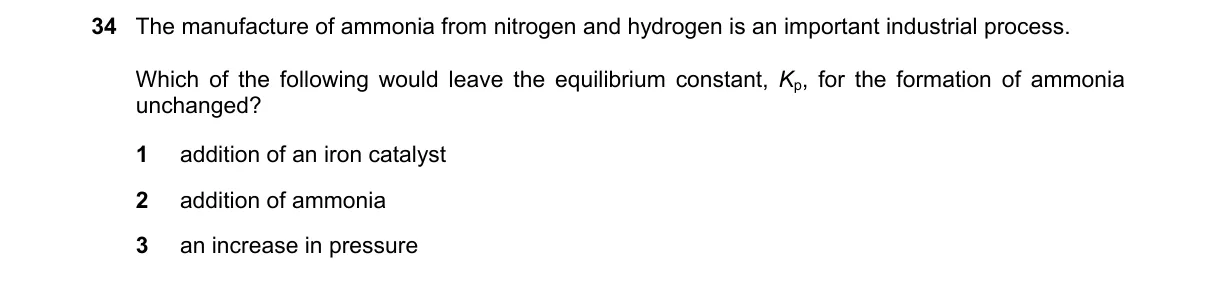
Answer choices
- Aaddition of a catalyst
- Baddition of iron catalyst
- Can increase in pressure
- Daddition of ammonia
Explanation
Catalysts Do Not Affect the Equilibrium Constant
Steps:
- Recall that the equilibrium constant K for N2 + 3H2 ⇌ 2NH3 depends only on temperature.
- A catalyst speeds up the forward and reverse rates equally, leaving the ratio of rate constants (K = k_forward / k_reverse) unchanged.
- Pressure and concentration changes shift the position of equilibrium per Le Chatelier's principle but do not alter K.
- Select the option that affects neither K nor the position: addition of a catalyst.
Why A is correct:
- Catalysts lower activation energies equally for forward and reverse reactions, preserving K as defined by the rate constant ratio.
Why the others are wrong:
- B: Specifies the iron catalyst used in the Haber process, but this is a distractor; the general principle applies to A.
- C: Increases pressure shifts equilibrium toward fewer gas moles (products), changing concentrations while K stays constant.
- D: Adds product (ammonia), shifting equilibrium left to restore K, thus changing concentrations.
Final answer: A
Topic: Equilibria
Practice more A Levels Chemistry (9701) questions on mMCQ.me