A Levels Chemistry (9701)•9701/12/M/J/19
A Levels Chemistry (9701) — 9701/12/M/J/19, Question 19
Which reaction gives a product that is an atmospheric pollutant causing acid rain
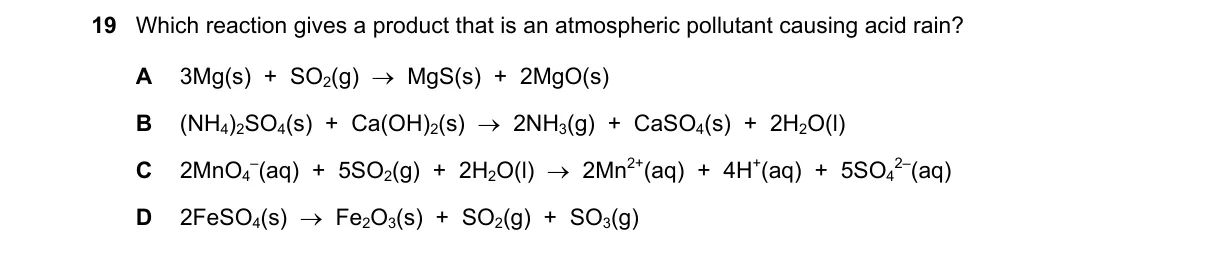
Answer choices
- A(NH₄)₂SO₄(s) + Ca(OH)₂(s) → 2NH₃(g) + CaSO₄(s) + 2H₂O(l)
- B2MnO₄(aq) + SO₂(g) + 2H₂O → 2Mn²⁺(aq) + 4H⁺(aq) + SO₄²⁻(aq)
- CFeSO₄(s) → Fe₂O₃(s) + SO₂(g) + SO₃(g)
- D2FeSO₄(s) → Fe₂O₃(s) + SO₂(g) + SO₃(g)
Explanation
Thermal decomposition producing sulfur oxides
Steps:
- Recall acid rain forms from atmospheric SO₂ and SO₃ reacting with water to make H₂SO₄.
- Identify gaseous products in each reaction that match these pollutants.
- Check reaction balance to ensure validity.
- Select the balanced reaction yielding SO₂(g) and SO₃(g).
Why D is correct:
- 2FeSO₄(s) → Fe₂O₃(s) + SO₂(g) + SO₃(g) is balanced and produces SO₂ and SO₃, which oxidize in air to form H₂SO₄ causing acid rain.
Why the others are wrong:
- A: Produces NH₃(g), a base not linked to acid rain.
- B: Consumes SO₂(g) as reactant, no pollutant product.
- C: Unbalanced (1 Fe and 1 S on left, 2 each on right), invalid reaction.
Final answer: D
Topic: Nitrogen and sulfur
Practice more A Levels Chemistry (9701) questions on mMCQ.me