A Levels Chemistry (9701)•9701/11/M/J/19
A Levels Chemistry (9701) — 9701/11/M/J/19, Question 9
Ethanoic acid, HCOOH, can be oxidized by KMnO4 in dilute sulfuric acid. The products of this reaction are carbon dioxide, water, potassium sulfate and manganese(II) sulfate. In this reaction each ethanoic acid molecule loses two electrons as it is oxidized. A half-equation for this process is shown. How many water molecules are produced when five ethanoic acid molecules are oxidized by KMnO4 in dilute sulfuric acid.
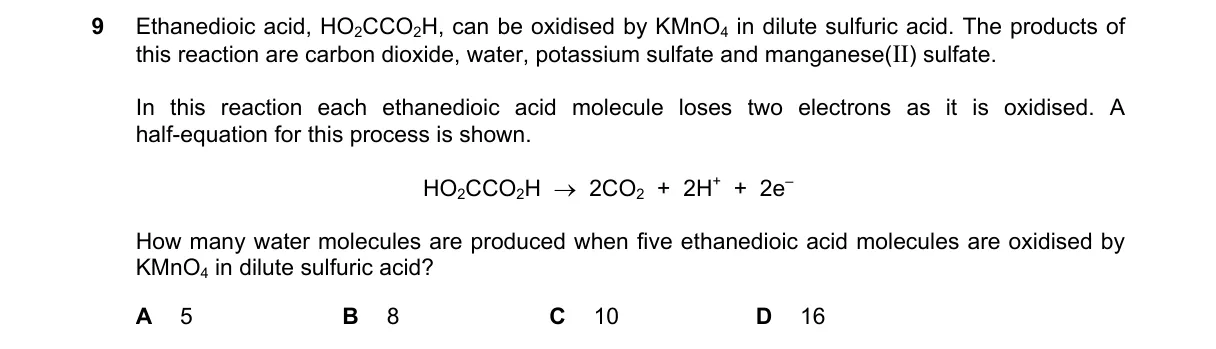
Answer choices
- A5
- B8
- C10
- D16
Explanation
Balancing redox reaction for water production
Steps:
- Oxidation half-equation: HCOOH → CO2 + 2H⁺ + 2e⁻ (loses 2 electrons per molecule).
- For five HCOOH: 5HCOOH → 5CO₂ + 10H⁺ + 10e⁻.
- Reduction half-equation (acidic): MnO₄⁻ + 8H⁺ + 5e⁻ → Mn²⁺ + 4H₂O; multiply by 2 for 10e⁻: 2MnO₄⁻ + 16H⁺ + 10e⁻ → 2Mn²⁺ + 8H₂O.
- Combine and simplify: net reaction produces 8H₂O from reduction, unaffected by H⁺ cancellation.
Why B is correct:
- Two MnO₄⁻ ions required to accept 10 electrons from five HCOOH, yielding 8H₂O per the reduction half-equation.
Why the others are wrong:
- A: Assumes 1H₂O per HCOOH, ignoring reduction stoichiometry.
- C: Might double-count H₂O from oxidation protons, but water comes only from reduction.
- D: Overcounts by assuming 4H₂O per MnO₄⁻ without electron balancing.
Final answer: B
Topic: Carboxylic acids and derivatives
Practice more A Levels Chemistry (9701) questions on mMCQ.me