A Levels Chemistry (9701)•9701/11/M/J/19
A Levels Chemistry (9701) — 9701/11/M/J/19, Question 27
An organic compound T undergoes the following reactions. • T is oxidised by hot acidified potassium manganate(VII). What compound T reacts with sodium to give hydrogen.
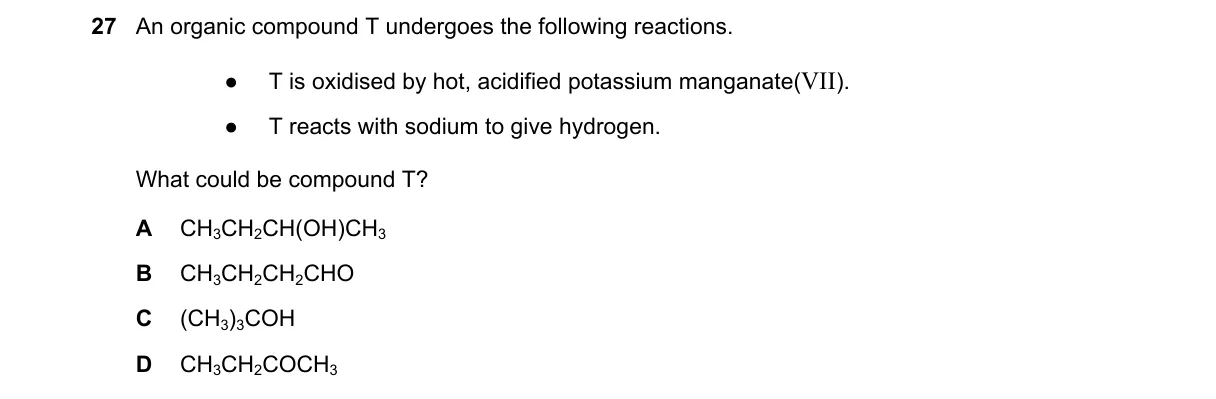
Answer choices
- ACH3CH2CH2OH
- BCH3CH(OH)CH3
- C(CH3)2CHOH
- DCH3COCH3
Explanation
Primary alcohol identification via oxidation product reacting with sodium Steps:
- Reaction with sodium liberating H₂ indicates an -OH group in T, typical of alcohols.
- Hot acidified KMnO₄ oxidizes alcohols: primary to carboxylic acids, secondary to ketones, tertiary/ketones unchanged.
- The query implies the oxidation product reacts with sodium to give H₂, which carboxylic acids do (2RCOOH + 2Na → 2RCOONa + H₂) but ketones do not.
- Thus, T is a primary alcohol, matching option A (CH₃CH₂CH₂OH oxidized to CH₃CH₂COOH).
Why A is correct:
- CH₃CH₂CH₂OH (propan-1-ol) is primary; oxidation gives propanoic acid, which reacts with Na per the reaction 2CH₃CH₂COOH + 2Na → 2CH₃CH₂COONa + H₂.
Why the others are wrong:
- B: CH₃CH(OH)CH₃ is secondary; oxidation gives CH₃COCH₃ (ketone), which does not liberate H₂ with Na.
- C: (CH₃)₂CHOH is secondary; same as B, oxidation product (ketone) does not react with Na to give H₂.
- D: CH₃COCH₃ is a ketone; not oxidized by KMnO₄.
Final answer: A
Topic: Hydroxy compounds
Practice more A Levels Chemistry (9701) questions on mMCQ.me