A Levels Chemistry (9701)•9701/11/M/J/19
A Levels Chemistry (9701) — 9701/11/M/J/19, Question 26
Methylhexan-3-ol reacts with hot, concentrated sulfuric acid to form several isomeric compounds with the molecular formula C7H14. Structural isomerism and stereoisomerism should be considered when answering this question. How many isomeric compounds could be formed in this reaction?
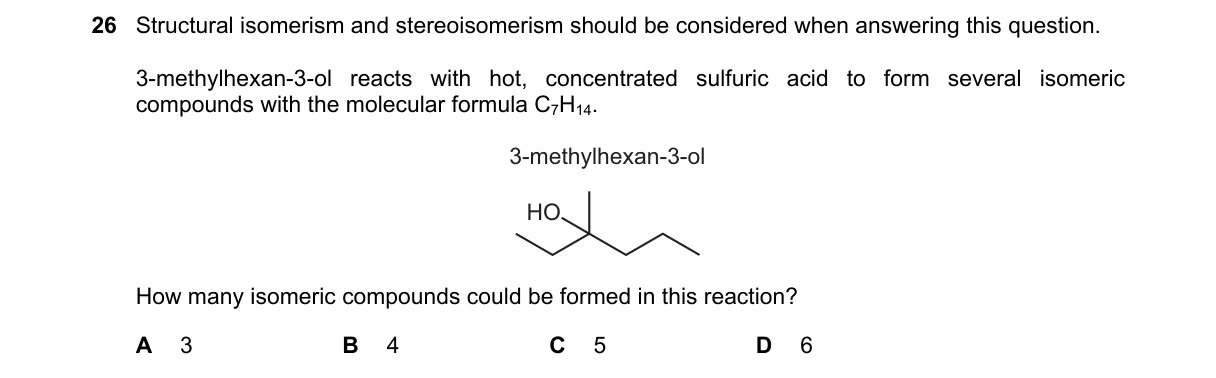
Answer choices
- A3
- B4
- C5
- D6
Explanation
Dehydration of 3-methylhexan-3-ol forms C7H14 alkenes via E1 mechanism
Steps:
- Tertiary alcohol dehydrates to carbocation at C3: CH3CH2C+(CH3)CH2CH2CH3.
- β-hydrogens lost from C2 (CH2), C4 (CH2), or methyl on C3 (CH3).
- Loss from C2 yields 3-methylhex-2-ene with E/Z stereoisomers due to different substituents on C2 and C3.
- Loss from C4 yields 3-methylhex-3-ene with E/Z stereoisomers due to ethyl/methyl on C3 and H/ethyl on C4.
- Loss from methyl yields 3-methylidenehexane with no stereoisomers as =CH2 is symmetric.
Why C is correct:
- Exactly five isomers: two E/Z pairs (four) plus one terminal alkene, per Zaitsev's rule and stereoisomer definition for disubstituted alkenes.
Why the others are wrong:
- A: Counts only three structural isomers, ignoring E/Z stereoisomerism.
- B: Counts four, possibly two E/Z and two structures, missing the exocyclic alkene.
- D: Counts six, incorrectly assuming carbocation rearrangement adds extra products.
Final answer: C
Topic: Hydroxy compounds
Practice more A Levels Chemistry (9701) questions on mMCQ.me