A Levels Chemistry (9701)•9701/11/M/J/19
A Levels Chemistry (9701) — 9701/11/M/J/19, Question 25
The structure of coniine is shown. Coniine can be synthesised by reacting ammonia with a dibromo compound, X. NH₃ + C₅H₁₀Br₂ → coniine + 2HBr What is the name of compound X?
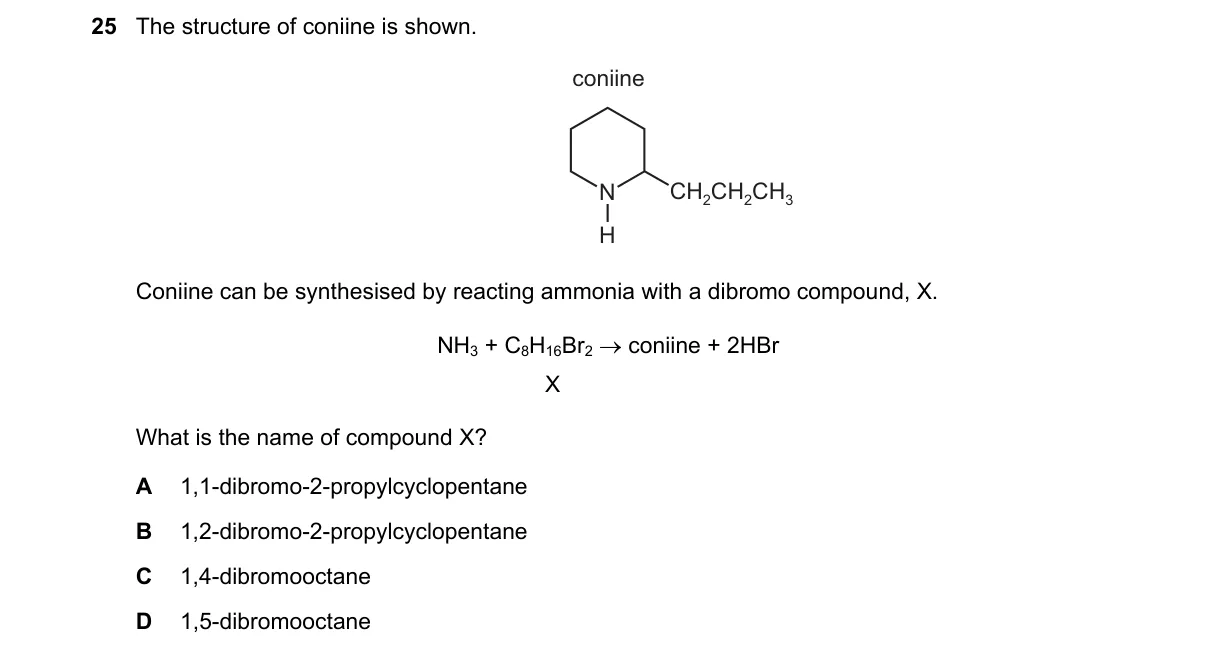
Answer choices
- A1,2-dibromopropane
- B1,1-dibromo-2-propylcyclopentane
- C1,4-dibromooctane
- D1,5-dibromooctane
Explanation
Coniine synthesis by ammonia cyclization of a 1,5-dibromoalkane Steps:
- Coniine is 2-propylpiperidine, a 6-membered ring with N and a propyl substituent at position 2 (C₈H₁₇N).
- Ammonia reacts with a dibromide via double alkylation to form the ring, requiring 5 carbons between Br atoms for piperidine.
- The propyl group (3 carbons) attaches to one terminal carbon, making the total chain an 8-carbon straight chain.
- Thus, Br at positions 1 and 5 on octane places the propyl (carbons 6-8) correctly for the 2-position after cyclization.
Why D is correct:
- 1,5-Dibromooctane (Br-CH₂-(CH₂)₃-CHBr-(CH₂)₂-CH₃) has 5 carbons from C1 to C5; N links C1 and C5, forming piperidine with propyl on C5 (position 2).
Why the others are wrong:
- A: 1,2-Dibromopropane (C₃H₆Br₂) has only 2 carbons between Br, forming aziridine, not piperidine.
- B: 1,1-Dibromo-2-propylcyclopentane is a geminal dibromide on a 5-membered ring, preventing linear chain cyclization to piperidine.
- C: 1,4-Dibromooctane has 4 carbons between Br (C1 to C4), forming 5-membered pyrrolidine with butyl substituent, not 2-propylpiperidine.
Final answer: D
Topic: Organic synthesis
Practice more A Levels Chemistry (9701) questions on mMCQ.me