A Levels Chemistry (9701)•9701/11/M/J/19
A Levels Chemistry (9701) — 9701/11/M/J/19, Question 23
Which reaction is most likely to involve the formation of a positively charged intermediate?
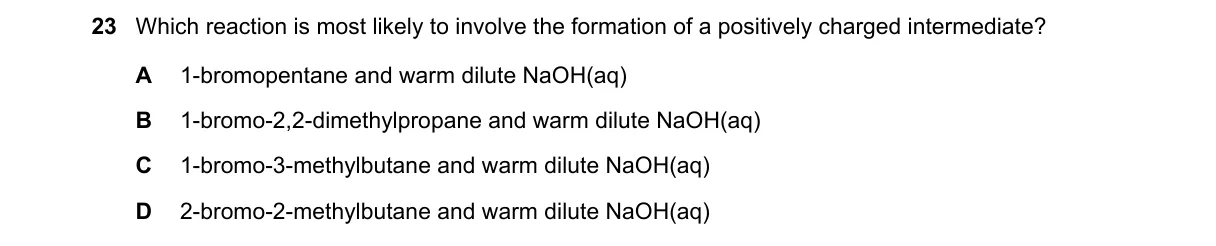
Answer choices
- A1-bromopropane and warm dilute NaOH(aq)
- B1-bromo-2-methylpropane and warm dilute NaOH(aq)
- C1-bromo-3-methylbutane and warm dilute NaOH(aq)
- D2-bromo-2-methylbutane and warm dilute NaOH(aq)
Explanation
Tertiary alkyl halides favor SN1 with carbocation intermediate
Steps:
- Classify each alkyl halide by carbon type: primary (1°), secondary (2°), or tertiary (3°).
- Recall warm dilute NaOH(aq) promotes nucleophilic substitution; 1° halides use SN2 (no carbocation), while 3° halides use SN1 (carbocation intermediate).
- Examine structures: A, B, C are 1°; D is 3° at the Br-bearing carbon.
- Conclude D is most likely for positively charged (carbocation) intermediate due to 3° stability.
Why D is correct:
- 2-Bromo-2-methylbutane is tertiary, favoring SN1 where Br leaves to form stable (CH3)2C(+)-CH2CH3 carbocation.
Why the others are wrong:
- A: 1-Bromopropane is primary, undergoes SN2 with backside attack, no carbocation.
- B: 1-Bromo-2-methylpropane is primary, undergoes SN2, no carbocation.
- C: 1-Bromo-3-methylbutane is primary, undergoes SN2, no carbocation.
Final answer: D
Topic: Halogen compounds
Practice more A Levels Chemistry (9701) questions on mMCQ.me