A Levels Chemistry (9701)•9701/11/M/J/19
A Levels Chemistry (9701) — 9701/11/M/J/19, Question 16
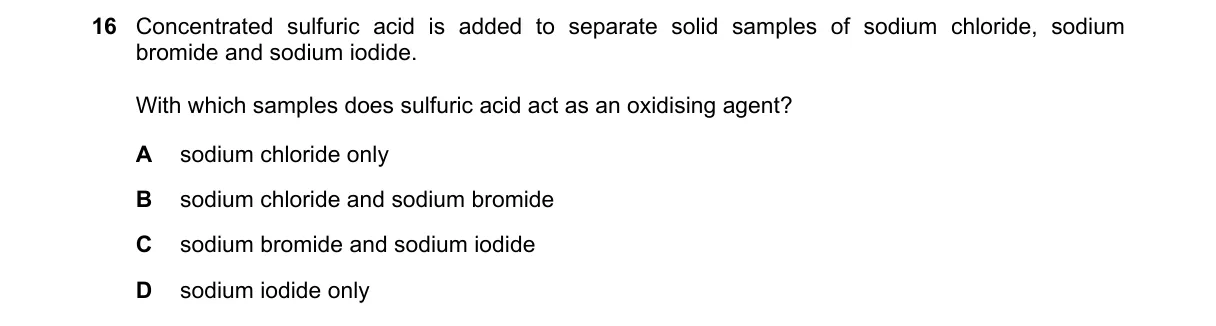
Concentrated sulfuric acid is added to separate solid samples of sodium chloride, sodium bromide and sodium iodide. With which samples does sulfuric acid act as an oxidizing agent?
Answer choices
- Asodium chloride only
- Bsodium chloride and sodium bromide
- Csodium bromide and sodium iodide
- Dsodium iodide only
Explanation
Sulfuric acid oxidizes bromide and iodide but not chloride
Steps:
- Concentrated H₂SO₄ reacts with NaCl to form HCl gas without oxidation, as Cl⁻ is not easily oxidized.
- With NaBr, H₂SO₄ oxidizes Br⁻ to Br₂ (via SO₄²⁻ + 2Br⁻ → SO₄²⁻ + Br₂ + 2e⁻), producing reddish-brown fumes.
- With NaI, H₂SO₄ oxidizes I⁻ to I₂ (via SO₄²⁻ + 2I⁻ → SO₄²⁻ + I₂ + 2e⁻), forming violet vapors.
- Oxidation occurs only for Br⁻ and I⁻ due to their lower reduction potentials compared to Cl⁻.
Why C is correct:
- H₂SO₄ acts as an oxidizing agent with NaBr and NaI because the standard reduction potential of SO₄²⁻/SO₂ (0.17 V) is sufficient to oxidize Br⁻ (-1.07 V) and I⁻ (-0.54 V), but not Cl⁻ (-1.36 V).
Why the others are wrong:
- A: H₂SO₄ does not oxidize Cl⁻, only displaces it as HCl.
- B: Includes NaCl, which undergoes no oxidation.
- D: Excludes NaBr, which is oxidized to Br₂.
Final answer: C
Topic: Group 17
Practice more A Levels Chemistry (9701) questions on mMCQ.me