A Levels Chemistry (9701)•9701/11/M/J/19
A Levels Chemistry (9701) — 9701/11/M/J/19, Question 13
The relative melting points of four consecutive elements in the Periodic Table are shown in the graph. The elements all have proton numbers less than 20. Which element is in Group 17?
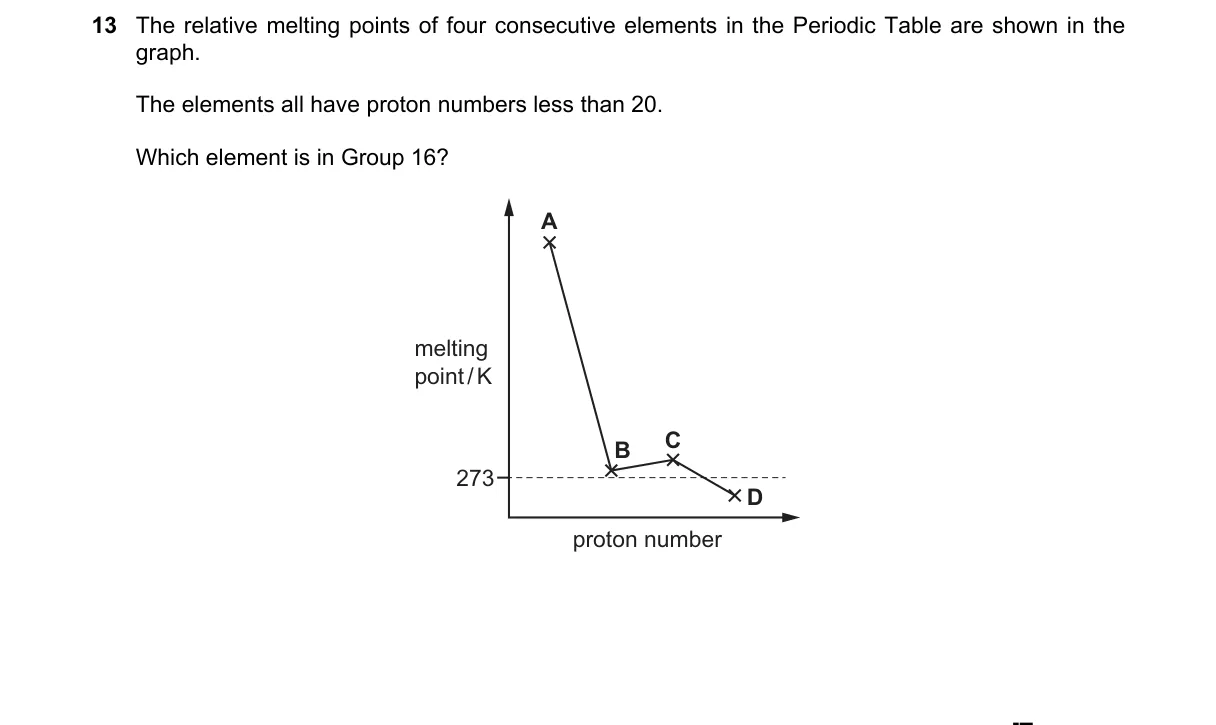
Answer choices
- AOption A
- BOption B
- COption C
- DOption D
Explanation
Halogens exhibit low melting points due to weak intermolecular forces
Steps:
- Identify four consecutive elements with atomic numbers <20 including Group 17: phosphorus (15), sulfur (16), chlorine (17), argon (18).
- Recall melting point trend: phosphorus (44°C) and sulfur (115°C) higher due to network/covalent structures; chlorine (-101°C) low as diatomic gas; argon (-189°C) lowest as noble gas.
- Analyze graph: shows rise to sulfur, sharp drop at chlorine, further drop at argon.
- Match options to positions: A (P), B (S), C (Cl), D (Ar); C shows the halogen's distinct low point.
Why C is correct:
- Chlorine (Group 17) has low melting point from weak van der Waals forces in Cl₂ molecules, per periodic trends.
Why the others are wrong:
- A: Phosphorus in Group 15, higher melting point from polymeric structure.
- B: Sulfur in Group 16, highest melting point from S₈ rings.
- D: Argon in Group 18, low but not Group 17; monatomic noble gas.
Final answer: C
Topic: The Periodic Table: chemical periodicity
Practice more A Levels Chemistry (9701) questions on mMCQ.me