A Levels Chemistry (9701)•9701/11/M/J/19
A Levels Chemistry (9701) — 9701/11/M/J/19, Question 1
The temperature of a sample of inert gas is increased. What effect does this have on the number of molecules with the most probable energy and on the number of molecules with high energy?
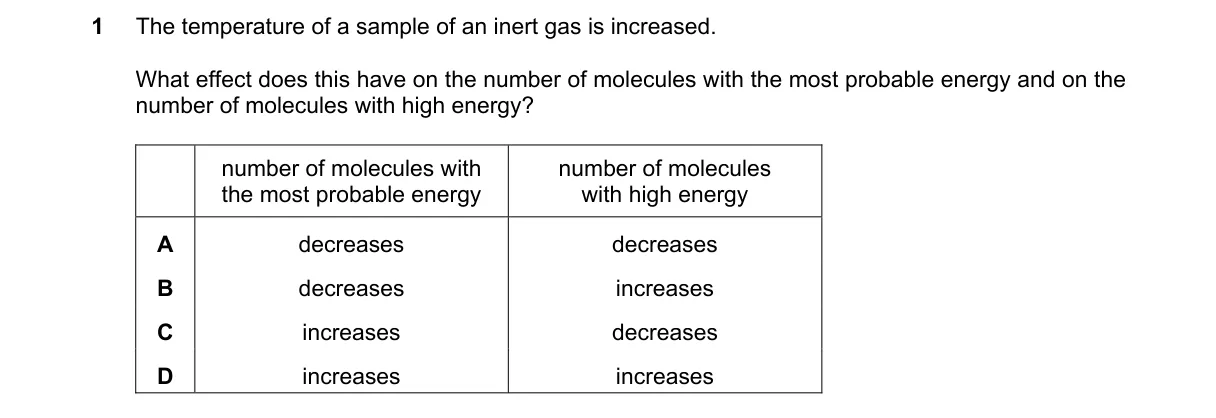
Answer choices
- Anumber of molecules with the most probable energy: decreases; number of molecules with high energy: decreases
- Bnumber of molecules with the most probable energy: increases; number of molecules with high energy: decreases
- Cnumber of molecules with the most probable energy: decreases; number of molecules with high energy: increases
- Dnumber of molecules with the most probable energy: increases; number of molecules with high energy: increases
Explanation
Maxwell-Boltzmann Distribution Broadens with Temperature Steps:
- Maxwell-Boltzmann distribution gives the fraction of molecules with kinetic energy E as proportional to √E exp(-E/kT).
- Most probable energy E_mp = ½ kT increases with T, but peak height g(E_mp) ∝ 1/T decreases as distribution spreads.
- Total molecules fixed, so number around E_mp drops due to lower peak density.
- For high E (E >> kT), fraction ∝ exp(-E/kT) rises with T, increasing molecules in high-energy tail.
Why C is correct:
- Peak density at E_mp scales as 1/T from the distribution formula, decreasing molecules there; high-energy tail grows via reduced -E/kT exponent.
Why the others are wrong:
- A: High-energy molecules increase, not decrease.
- B: Most probable energy molecules decrease, not increase; high-energy increases, not decrease.
- D: Most probable energy molecules decrease, not increase.
Final answer: C
Topic: States of matter
Practice more A Levels Chemistry (9701) questions on mMCQ.me