A Levels Chemistry (9701)•9701/13/M/J/18
A Levels Chemistry (9701) — 9701/13/M/J/18, Question 5
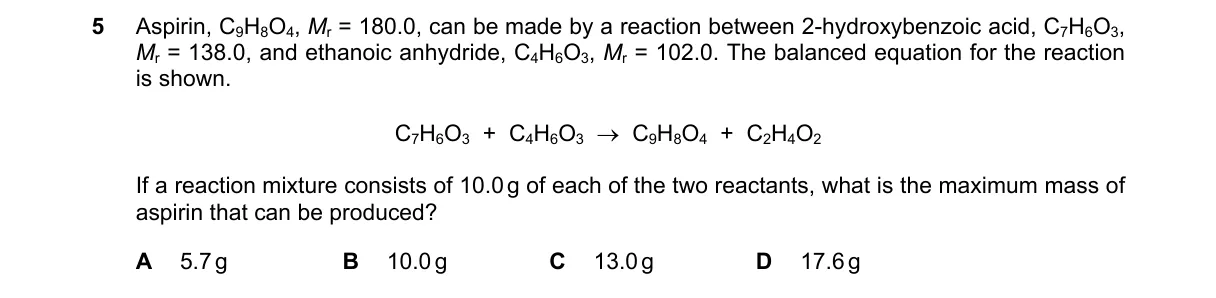
Aspirin, C9H8O4, M=180, can be made by a reaction between 2-hydroxybenzoic acid, C7H6O3, M=138.0 and ethanoic anhydride, (CH3CO)2O, M=102. The balanced equation for the reaction is shown. C7H6O3 + (CH3CO)2O → C9H8O4 + CH3COOH If a reaction mixture consists of 10.0g of each of the two reactants, what is the maximum mass of aspirin that can be produced?
Answer choices
- A5.7g
- B10.0g
- C13.0g
- D17g
Explanation
Limiting reactant calculation for aspirin yield
Steps:
- Moles of 2-hydroxybenzoic acid: 10.0 g / 138 g/mol = 0.0725 mol.
- Moles of ethanoic anhydride: 10.0 g / 102 g/mol = 0.0980 mol.
- Acid is limiting (1:1 ratio, fewer moles than anhydride).
- Maximum aspirin: 0.0725 mol × 180 g/mol = 13.0 g.
Why C is correct:
- 13.0 g matches mass from limiting reactant's moles times aspirin's molar mass (stoichiometric yield formula).
Why the others are wrong:
- A: Underestimates by ignoring full conversion of limiting reactant.
- B: Assumes 1:1 mass ratio, ignores molar masses and stoichiometry.
- D: Overestimates using anhydride moles, which is in excess.
Final answer: C
Topic: Carboxylic acids and derivatives
Practice more A Levels Chemistry (9701) questions on mMCQ.me