A Levels Chemistry (9701)•9701/13/M/J/18
A Levels Chemistry (9701) — 9701/13/M/J/18, Question 40
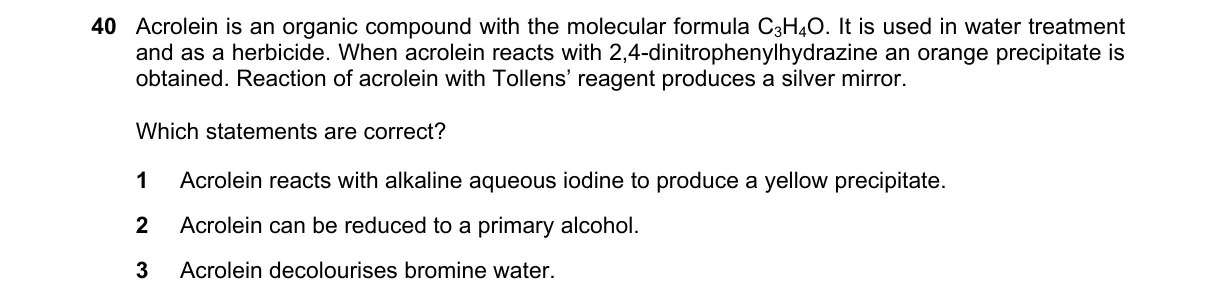
Acrolein is an organic compound with the molecular formula C3H4O. It is used in water treatment and as a herbicide. When acrolein reacts with 2,4-dinitrophenylhydrazine, an orange precipitate is obtained. Reaction of acrolein with Tollens' reagent produces a silver mirror. Which statements are correct?
Answer choices
- AAcrolein reacts with alkaline aqueous iodine to produce a yellow precipitate.
- BAcrolein can be reduced to a primary alcohol.
- CAcrolein decolourises bromine water.
- DOption D
Explanation
Acrolein is an α,β-unsaturated aldehyde
Steps:
- Deduce structure from C3H4O, DNPH orange precipitate, and Tollens' silver mirror: H2C=CHCHO.
- Confirm aldehyde functionality from given reactions.
- Check A for iodoform test applicability to structure.
- Check B for standard reduction of aldehyde group.
- Check C for alkene addition reaction.
Why C is correct:
- The C=C bond undergoes electrophilic addition with Br2, decolourising bromine water per the unsaturation test.
Why the others are wrong:
- A: Iodoform test requires CH3C(O)R or CH3CH(OH)R structure; acrolein has H2C=CHC(O)H, so no yellow CHI3 precipitate.
- B: α,β-Unsaturated aldehydes undergo conjugate (1,4) reduction with many agents, yielding propanal intermediate then propan-1-ol upon full reduction, but selective 1,2-reduction to allyl alcohol requires specific conditions; statement oversimplifies as "primary alcohol" without context.
- D: Not enough information.
Final answer: C
Topic: Carbonyl compounds
Practice more A Levels Chemistry (9701) questions on mMCQ.me