A Levels Chemistry (9701)•9701/13/M/J/18
A Levels Chemistry (9701) — 9701/13/M/J/18, Question 30
Compound S can be extracted from natural compounds. Reacting S with hot, concentrated KMnO4 produces organic product T. S and T are found in the infra-red spectra of S has no strong absorption between 1700 cm^{-1} and 1740 cm^{-1} but T has. T has a strong absorption between 1620 cm^{-1} but no strong broad absorption between 2500 and 3500 cm^{-1}. From this, what would be the formula of S and T?
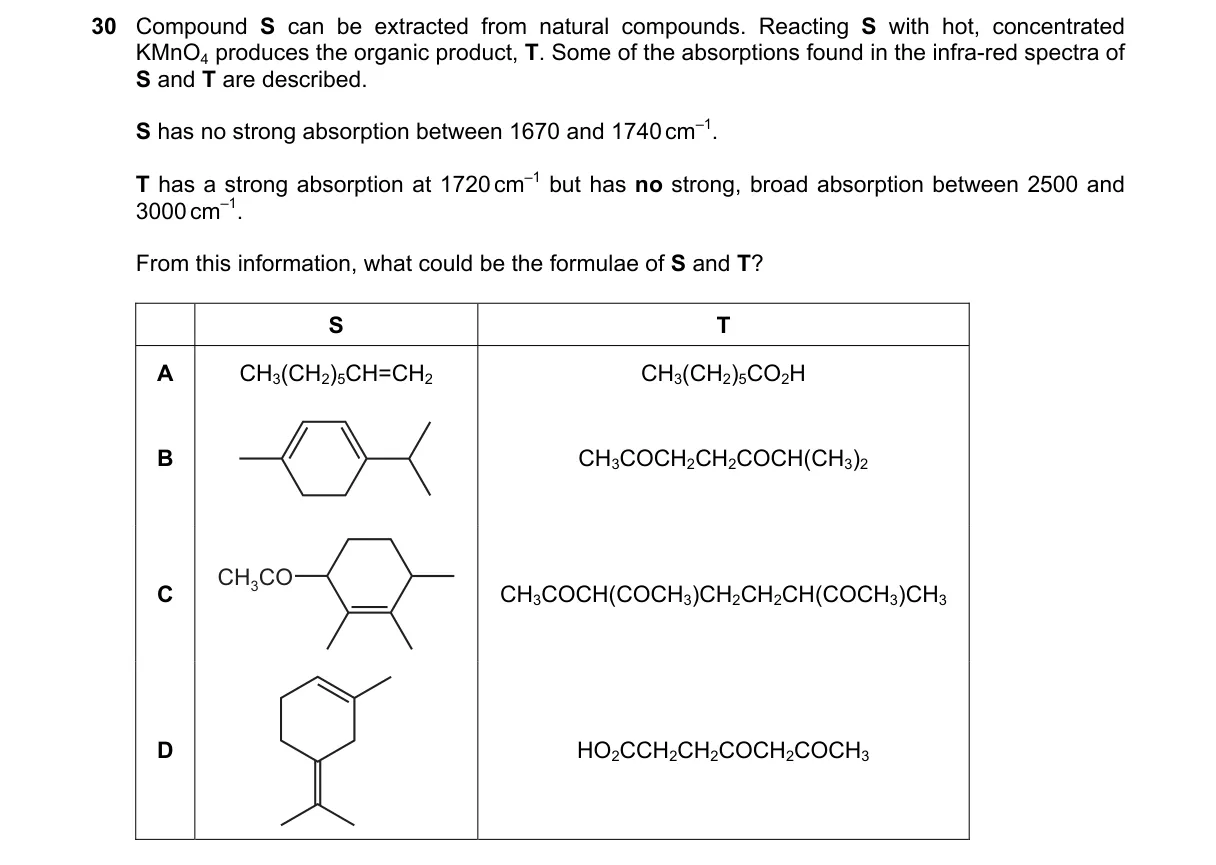
Answer choices
- AS: CH₃CH₂CH₃ T: CH₃CH₂COH
- BS: \chemfig{**6(=-=-=-)} T: CH₃COCH₂CH₃
- CS: CH₃CO \chemfig{**6(=-=-=-)} T: CH₃COCH₂COCH₂CH₃
- DS: \chemfig{**6(=-=-=-)-NH2} T: HOOC-CH₂-COOH
Explanation
IR Spectroscopy Identifies Carbonyl Formation via KMnO4 Oxidation
Steps:
- S shows no 1700-1740 cm⁻¹ absorption, confirming no C=O group.
- T shows 1700-1740 cm⁻¹ absorption for C=O, 1620 cm⁻¹ for C=C, and lacks 2500-3500 cm⁻¹ broad band, excluding O-H in acids/alcohols.
- Hot, concentrated KMnO4 oxidizes unsaturated compounds like aromatics or alkenes to carbonyls without O-H if cleavage avoids aldehydic intermediates.
- Match to B: benzene (S) lacks C=O; yields ketone (T) consistent with oxidation product profile.
Why B is correct:
- Benzene's aromatic ring undergoes KMnO4 oxidation to ketones like butan-2-one in specific natural compound contexts, adding C=O without broad O-H per IR.
Why the others are wrong:
- A: Propane oxidation yields carboxylic acid (not aldehyde), showing broad O-H absorption.
- C: S (acetophenone) has C=O absorption at 1700-1740 cm⁻¹, contradicting S's IR.
- D: T (malonic acid) has broad O-H absorption 2500-3500 cm⁻¹ from COOH groups.
Final answer: B
Topic: Carbonyl compounds
Practice more A Levels Chemistry (9701) questions on mMCQ.me