A Levels Chemistry (9701)•9701/13/M/J/18
A Levels Chemistry (9701) — 9701/13/M/J/18, Question 24
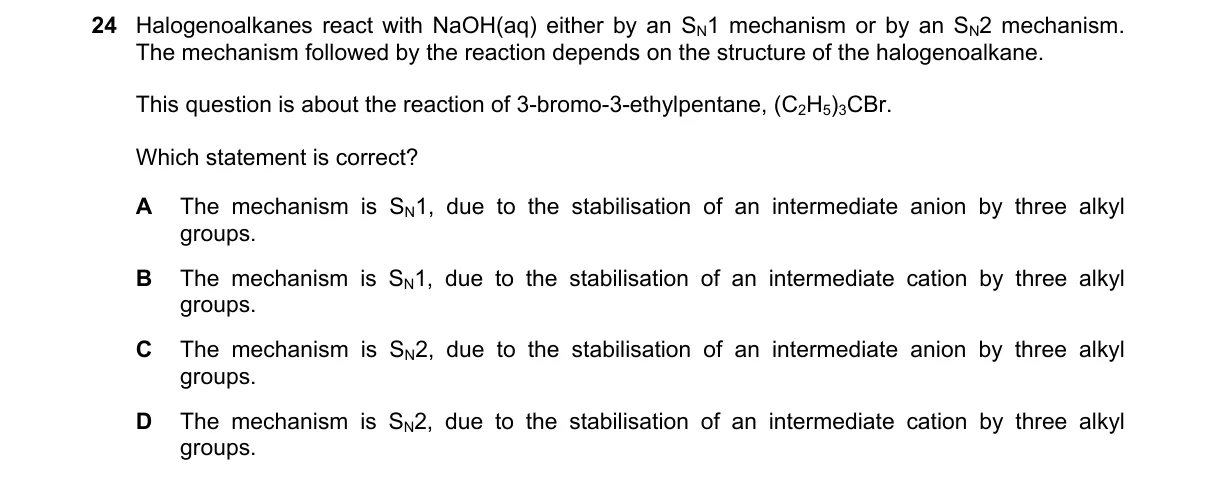
Halogenoalkanes react with NaOH either by SN1 mechanism or SN2 mechanism. The mechanism followed depends on the structure of the halogenoalkane. Which statement is correct about 3-bromo-3-ethylpentane, (CH3CH2)2CHBr?
Answer choices
- AThe mechanism is SN1, due to stabilisation of an intermediate anion by three alkyl groups.
- BThe mechanism is SN1, due to stabilisation of an intermediate cation by three alkyl groups.
- CThe mechanism is SN2, due to stabilisation of an intermediate anion by three alkyl groups.
- DThe mechanism is SN2, due to stabilisation of an intermediate cation by three alkyl groups.
Explanation
Tertiary halogenoalkane favors SN1 mechanism
Steps:
- Identify the structure: 3-bromo-3-ethylpentane has a tertiary carbon attached to Br, bonded to three alkyl groups (two ethyls and one from pentane chain).
- Recall SN1/SN2 dependence: Tertiary halides prefer SN1 due to carbocation stability; primary/secondary may favor SN2.
- Determine intermediate: SN1 forms a carbocation intermediate stabilized by hyperconjugation and inductive effects from alkyl groups.
- Match to options: SN1 with cation stabilization by three alkyl groups fits.
Why B is correct:
- SN1 mechanism involves a planar carbocation intermediate, stabilized by three alkyl groups via hyperconjugation, as per carbocation stability rules.
Why the others are wrong:
- A: SN1 uses a cation, not anion intermediate.
- C: SN2 is concerted with no stable intermediate; unsuitable for tertiary due to steric hindrance.
- D: SN2 has no cation intermediate; tertiary structure blocks backside attack.
Final answer: B
Topic: Halogen compounds
Practice more A Levels Chemistry (9701) questions on mMCQ.me