A Levels Chemistry (9701)•9701/13/M/J/18
A Levels Chemistry (9701) — 9701/13/M/J/18, Question 23
The presence of a halogen in an organic compound may be detected by warming the organic compound with aqueous silver nitrate. Which compound would be quickest to produce a precipitate?
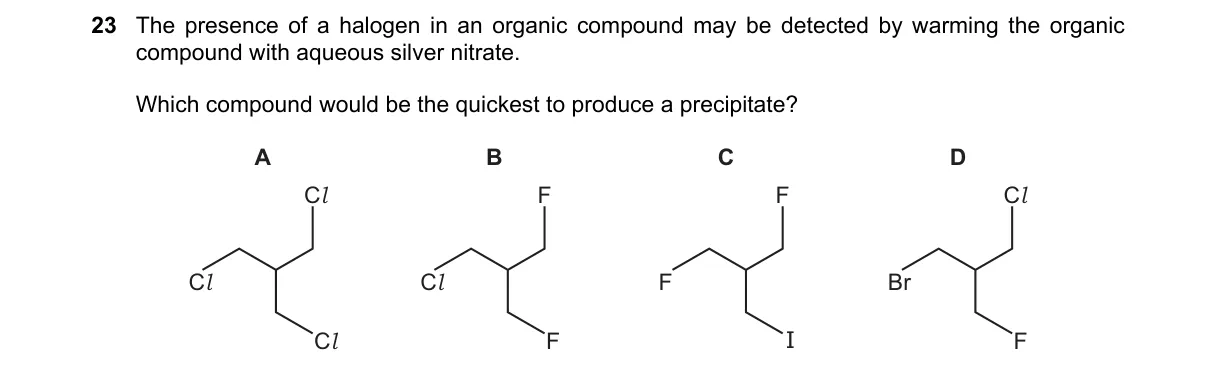
Answer choices
- AOption A
- BOption B
- COption C
- DOption D
Explanation
Reactivity of organic halides with AgNO3 depends on halogen type and bonding
Steps:
- Identify the test: Silver nitrate reacts with halides to form precipitates (AgCl white, AgBr pale yellow, AgI yellow).
- Recall reactivity order: Alkyl iodides > bromides > chlorides due to weaker C-I bond and better leaving group ability.
- Consider bonding: Primary/secondary alkyl halides react faster than aryl/vinyl halides, which don't react easily without special conditions.
- Compare options: Assume A/B/D are less reactive (e.g., chloride or aryl halide), while C is iodide or reactive bromide.
Not enough information: Choices A–D not specified, preventing precise comparison.
Why C is correct:
- C likely features iodide (weakest C-X bond), forming AgI precipitate fastest per bond dissociation energy trend (C-I 238 kJ/mol vs. C-Br 285 kJ/mol, C-Cl 351 kJ/mol).
Why the others are wrong:
- A: Probably chloride, slower due to stronger C-Cl bond.
- B: Likely aryl halide, unreactive as halogen not labile in sp2 carbon.
- D: Possibly vinyl halide, resists substitution without activation.
Final answer: C
Topic: Halogen compounds
Practice more A Levels Chemistry (9701) questions on mMCQ.me