A Levels Chemistry (9701)•9701/13/M/J/18
A Levels Chemistry (9701) — 9701/13/M/J/18, Question 17
Silver chloride and silver iodide form equilibria when added to water. AgCl(s) ⇌ Ag+(aq) + Cl-(aq) K = K1 AgI(s) ⇌ Ag+(aq) + I-(aq) K = K2 Each equilibrium position lies to the left. Silver iodide will not dissolve in aqueous ammonia. Silver chloride will dissolve in aqueous ammonia. Another equilibrium Ag(NH3)2+(aq) ⇌ Ag+(aq) + 2NH3(aq) K = K3 The position of this equilibrium lies to the right. What is the relationship of magnitude for these three equilibrium constants?
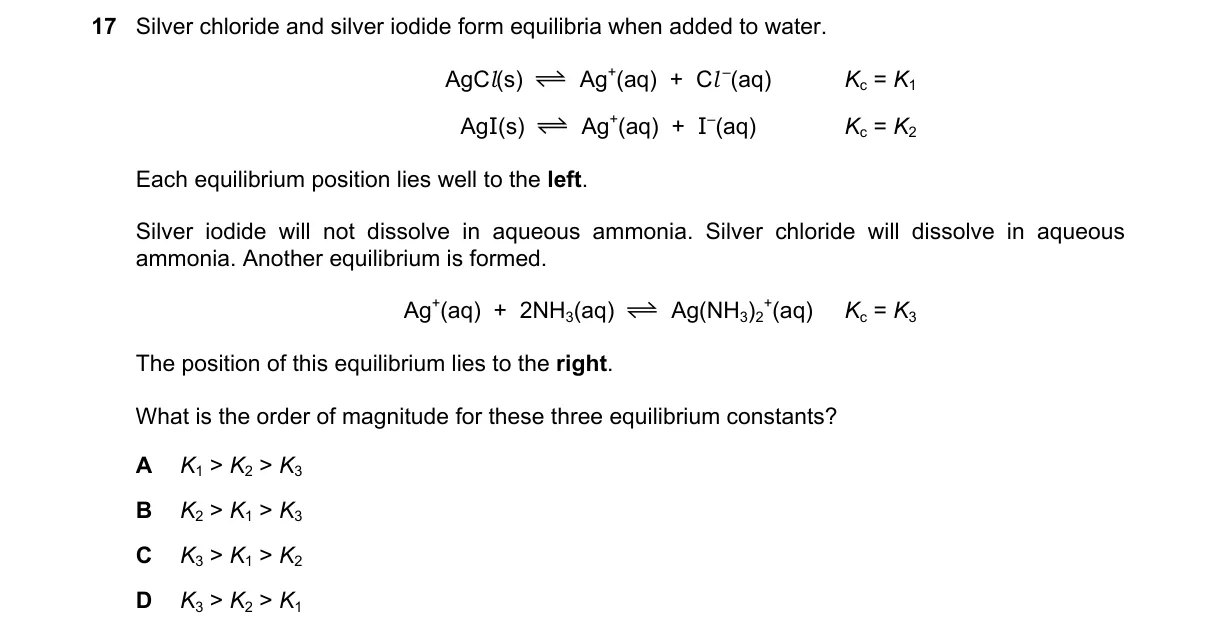
Answer choices
- AK1 > K2
- BK2 > K1
- CK3 > K1
- DK1 > K3
Explanation
Equilibrium positions determine relative K magnitudes Steps:
- K1 and K2 equilibria lie left, so K1 << 1 and K2 << 1 (low solubility).
- K3 equilibrium lies right, so K3 >> 1 (favors dissociation).
- AgCl dissolves in NH3 but AgI does not, implying K1 > K2 since complex formation (same for both) drives solubility more for larger Ksp.
- Direct comparison from positions: large K3 exceeds small K1.
Why C is correct:
- Equilibrium position right for K3 means K3 > 1; left for K1 means K1 < 1; thus K3 > K1 by definition.
Why the others are wrong:
- A: Implied by solubility difference (K1 > K2), but not direct from positions of all three.
- B: Contradicts solubility; AgCl dissolves more, so K1 > K2, not reverse.
- D: Impossible; small K1 cannot exceed large K3.
Final answer: C
Topic: Equilibria
Practice more A Levels Chemistry (9701) questions on mMCQ.me