A Levels Chemistry (9701)•9701/13/M/J/18
A Levels Chemistry (9701) — 9701/13/M/J/18, Question 16
When concentrated sulfuric acid is added to solid sodium chloride, HCl is formed but not Cl₂. When concentrated sulfuric acid is added to solid sodium iodide, HI is formed but not I₂. Which statement explains these observations?
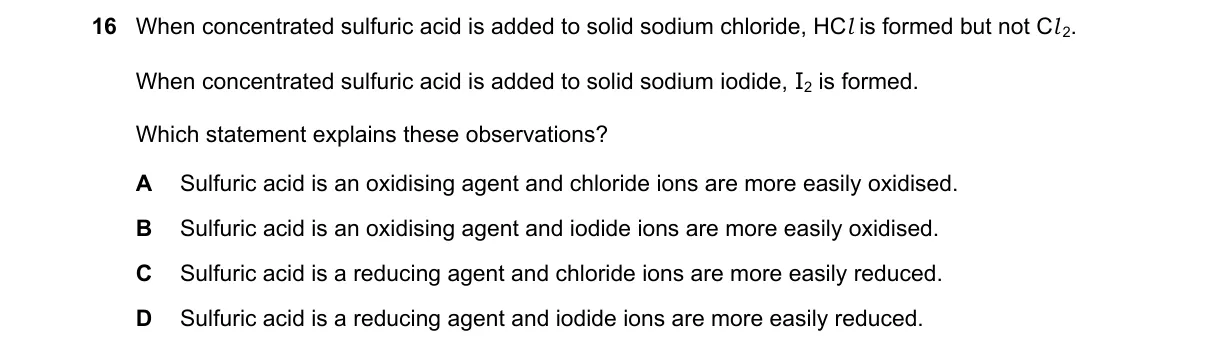
Answer choices
- ASulfuric acid is an oxidizing agent and chloride ions are more easily oxidized.
- BSulfuric acid is an oxidizing agent and iodide ions are more easily oxidized.
- CSulfuric acid is a reducing agent and chloride ions are more easily reduced.
- DSulfuric acid is a reducing agent and iodide ions are more easily reduced.
Explanation
Relative ease of halide ion oxidation by sulfuric acid
Steps:
- Concentrated H₂SO₄ acts as an oxidizing agent when reacting with metal halides.
- With NaCl, HCl forms because Cl⁻ resists oxidation to Cl₂ (E° Cl₂/Cl⁻ = +1.36 V, too high for H₂SO₄).
- With NaI, I⁻ oxidizes to I₂ (E° I₂/I⁻ = +0.54 V, feasible for H₂SO₄), preventing stable HI formation.
- The key difference lies in oxidation potentials, making I⁻ easier to oxidize than Cl⁻.
Why B is correct:
- H₂SO₄ oxidizes I⁻ more readily than Cl⁻ due to the lower standard reduction potential of I₂/I⁻, explaining no Cl₂ but I₂ formation.
Why the others are wrong:
- A: Cl⁻ is harder to oxidize than I⁻, not easier.
- C: H₂SO₄ acts as an oxidizing agent here, not reducing.
- D: H₂SO₄ is not a reducing agent, and ease of reduction is irrelevant.
Final answer: B
Topic: Group 17
Practice more A Levels Chemistry (9701) questions on mMCQ.me