A Levels Chemistry (9701)•9701/13/M/J/18
A Levels Chemistry (9701) — 9701/13/M/J/18, Question 13
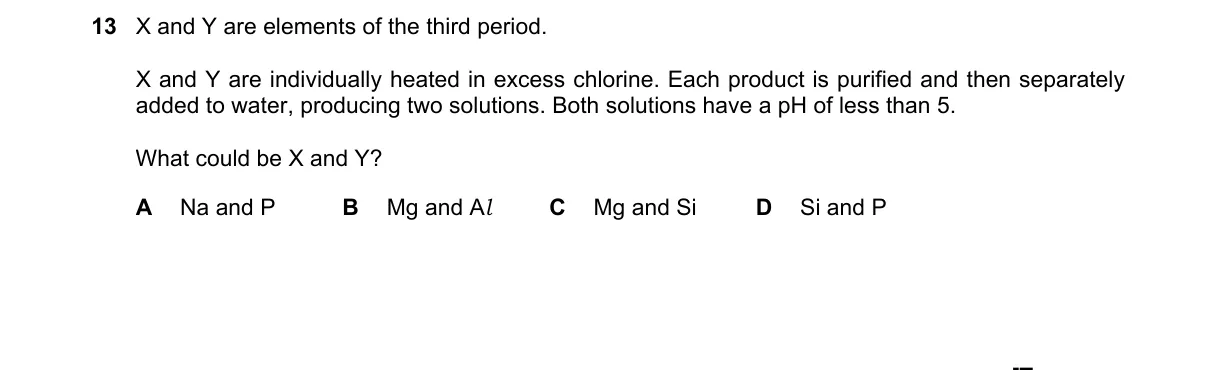
X and Y are elements of the third period. X and Y individually heated in excess chlorine. Each product is purified and then separately added to water, producing two solutions. Both solutions have pH less than 5.
Answer choices
- ANa and P
- BMg and Al
- CMg and Si
- DSi and P
Explanation
Chlorides of non-metals hydrolyze to acidic solutions
Steps:
- Third period elements form chlorides when heated in excess Cl₂: metals yield ionic chlorides, non-metals covalent ones.
- Ionic chlorides (e.g., NaCl, MgCl₂) dissolve neutrally or weakly acidic; covalent chlorides (e.g., SiCl₄, PCl₅) hydrolyze with water.
- Hydrolysis of SiCl₄ → Si(OH)₄ + 4HCl; PCl₅ → H₃PO₄ + 5HCl, both producing H⁺ for pH <5.
- Only Si and P yield chlorides that both give strongly acidic solutions.
Why D is correct:
- SiCl₄ and PCl₅ hydrolyze completely to release HCl, lowering pH below 5 per hydrolysis equations.
Why the others are wrong:
- A: NaCl is neutral (pH ~7), not <5.
- B: MgCl₂ is weakly acidic (pH ~6), not <5.
- C: MgCl₂ is weakly acidic (pH ~6), not <5.
Final answer: D
Topic: The Periodic Table: chemical periodicity
Practice more A Levels Chemistry (9701) questions on mMCQ.me