A Levels Chemistry (9701)•9701/13/M/J/18
A Levels Chemistry (9701) — 9701/13/M/J/18, Question 11
The enzyme maltase speeds up the reaction between maltose and water. maltose + water maltase glucose Which statement describes the specificity of maltase?
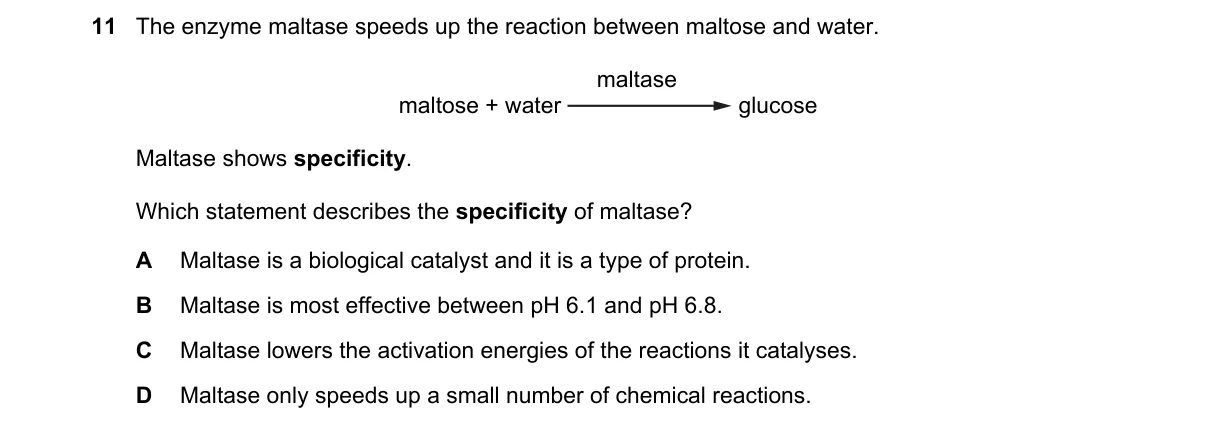
Answer choices
- AMaltase is a biological catalyst and it is a type of protein.
- BMaltase is most effective between pH 6 and pH 7.
- CMaltase lowers the activation energy of the reaction it catalyzes.
- DMaltase only speeds up a small number of chemical reactions.
Explanation
Enzyme Specificity Defined by Reaction Selectivity
Steps:
- Define specificity: Enzymes catalyze only specific substrates or reactions due to their active site structure.
- Analyze the reaction: Maltase targets maltose hydrolysis to glucose, indicating narrow action.
- Evaluate choices: Identify which option directly addresses limited reaction scope versus general traits.
- Select D: It matches specificity by limiting reactions catalyzed.
Why D is correct:
- Enzyme specificity, per biochemical definition, means an enzyme accelerates only select reactions matching its substrate (e.g., maltase acts solely on maltose, not other sugars).
Why the others are wrong:
- A: States general enzyme traits (catalyst, protein) without addressing reaction limits.
- B: Describes pH optimum for activity, unrelated to substrate selectivity.
- C: Explains general catalytic role (lowering activation energy) for any reaction it performs.
Final answer: D
Topic: Reaction kinetics
Practice more A Levels Chemistry (9701) questions on mMCQ.me