A Levels Chemistry (9701)•9701/12/M/J/18
A Levels Chemistry (9701) — 9701/12/M/J/18, Question 9
Materials can be classified by their chemical structures. Four common types of structure are metallic, ionic, simple molecular and giant molecular. Some physical properties of four substances are shown in the table. Which substance has a simple molecular structure?
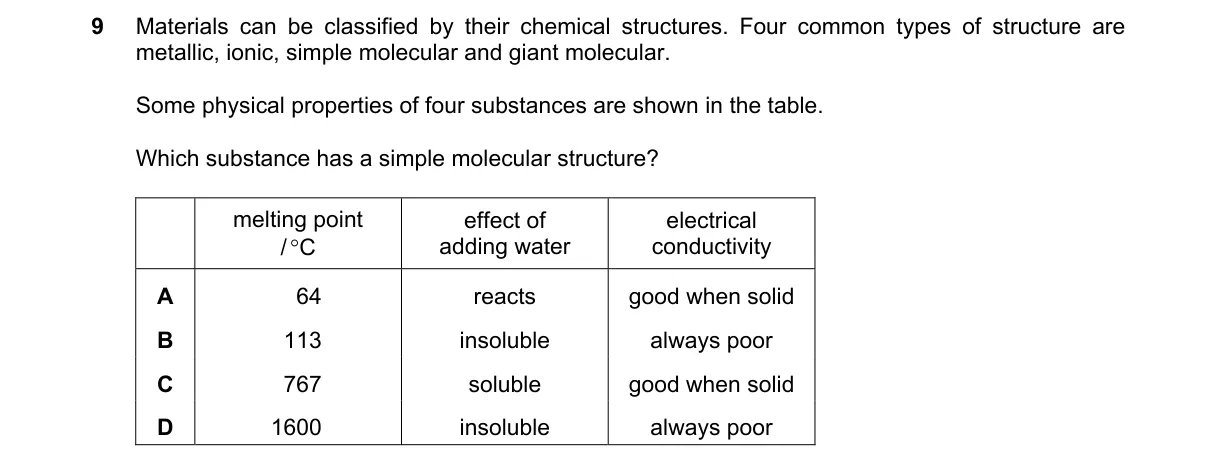
Answer choices
- Amelting point 64°C, effect of adding water reacts, electrical conductivity good conductivity
- Bmelting point 113, effect of adding water insoluble, electrical conductivity always poor
- Cmelting point 767, effect of adding water insoluble, electrical conductivity good when solid
- Dmelting point 1600, effect of adding water insoluble, electrical conductivity always poor
Explanation
Identifying simple molecular structure by low melting point and poor conductivity
Steps:
- Recall simple molecular structures have low melting points due to weak forces between molecules, are insoluble in water, and show poor electrical conductivity without free ions or electrons.
- Examine melting points: low (around 100°C or less) indicates simple molecular; high suggests metallic, ionic, or giant structures.
- Check solubility: simple molecular substances are typically insoluble in water.
- Verify conductivity: always poor for simple molecular, unlike metals (good in solid) or ionic (good when molten/dissolved).
Why B is correct:
- Melting point of 113°C is low, indicating weak intermolecular forces typical of simple molecular structures like iodine, with insolubility and always poor conductivity confirming no mobile charges.
Why the others are wrong:
- A: Reacts with water, characteristic of reactive ionic compounds like sodium.
- C: Good conductivity when solid, typical of metallic structures with delocalized electrons.
- D: High melting point of 1600°C indicates strong bonds in giant molecular (e.g., diamond) or ionic lattices.
Final answer: B
Topic: Chemical bonding
Practice more A Levels Chemistry (9701) questions on mMCQ.me